By Josie Bull. Published in Issue 23 of Paper Chained.
Convict-led opposition to British transportation sentences simmered throughout the 19th century. The Castle Hill Rebellion was Australia’s first organised uprising, highlighting Britain’s mistreatment of Irish political prisoners. Far from a mere criminal uprising, it marked one of the earliest acts of resistance against oppressive colonial rule; a system that would face growing scrutiny from Australian convicts and free settlers throughout the 1800s. Castle Hill aided in exposing the flaws of Britain’s penal system and laid the groundwork for future anti-colonialism protests.
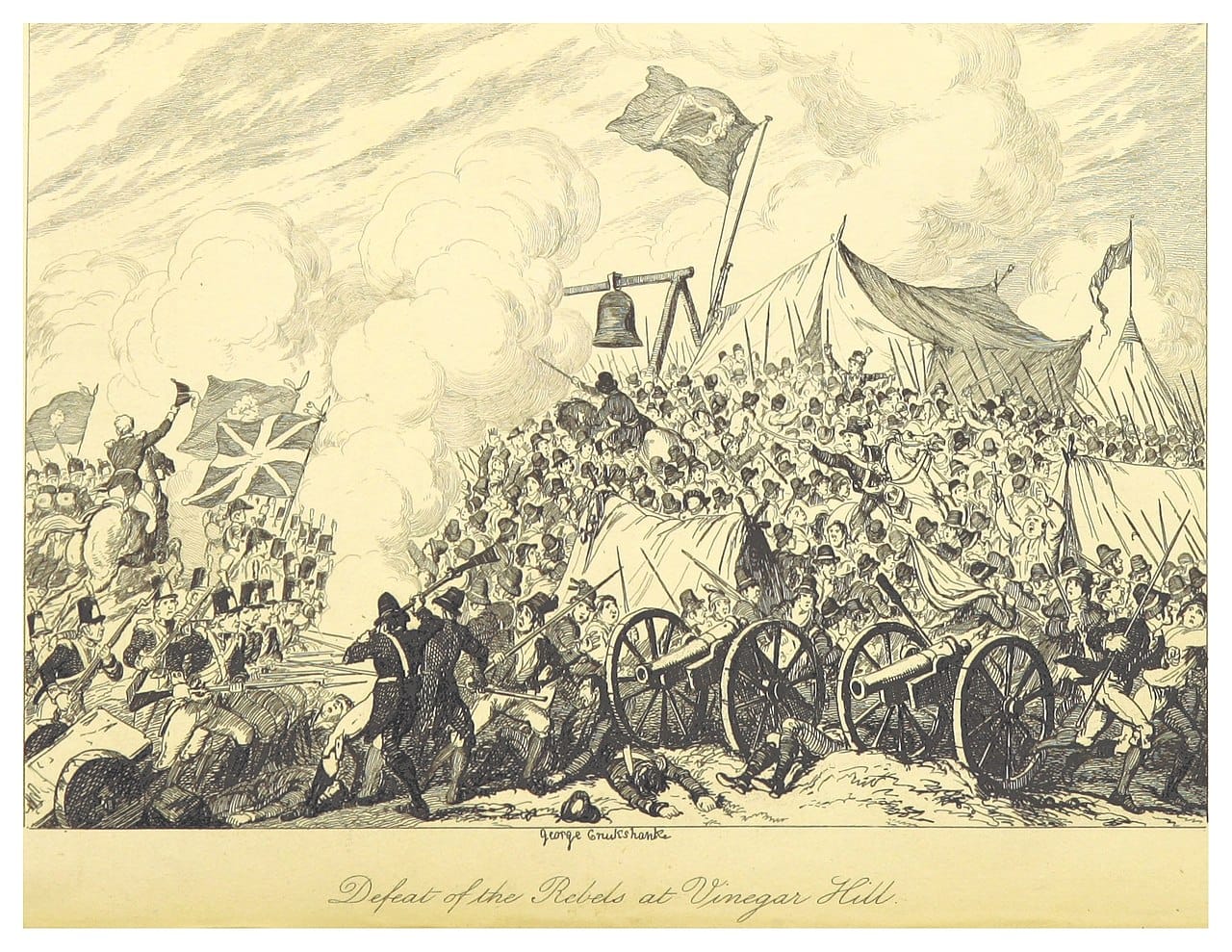
During the early years of colonisation, transportation sentences were primarily used to exile convicted criminals from the British Empire. However, in the wake of the 1776 American Revolution and the 1789 French Revolution, Britain grew increasingly wary of radical political movements. To curb political dissent, Britain began exiling political radicals to Australia. Inspired in part by the French revolutionaries, Ireland sought to establish an independent republic. In 1798, the Society of United Irishmen launched a rebellion against British rule, sparking battles across the country. The most infamous of these was the Battle of Vinegar Hill, where 16,000 rebels clashed with 13,000 British troops. The uprising was brutally suppressed, with thousands killed or captured by the British armed forces. Over 400 survivors were sentenced to transportation as political prisoners to the penal colonies of New South Wales.
Convict life in Australia was harsh, marked by forced labour, brutality, and isolation. Most men were deployed to build roads, bridges, and public buildings or worked on government farms. Educated convicts were assigned administrative jobs, while women served as domestic servants for colonial officers. Discipline was often arbitrary, with punishments given for even minor infractions, such as fifty lashes from the cat o’ nine tails, a lead-weighted whip capable of tearing skin. Veterans of Ireland’s Vinegar Hill were exiled to Australia alongside common thieves and forgers. Many remained determined to resist British oppression and longed to return home to resume their fight for Irish independence. Desperation grew between 1800 and 1804, and numerous small-scale rebellions emerged around Sydney and Norfolk Island, but most were intercepted before they could take shape.
Castle Hill Government Farm, filled with Irish convicts, became a hotbed of political unrest, particularly between 1801 and 1804. During this period, ships arriving in Sydney from Ireland brought not only more veterans of the 1798 Rebellion, but also news of Robert Emmet’s failed 1803 uprising in Dublin. Just six weeks after hearing of Emmet’s insurrection, following years of quiet planning, the Irish convicts at Castle Hill were moved to launch their rebellion. Irish rebel veteran Phillip Cunningham led the uprising alongside fellow countrymen William Johnston and Samuel Humes. Together, they assembled a force of around 250 men, intending to join around 1,000 other convicts fleeing the Hawkesbury River region. The plan was to rally at nearby settlements, march on Sydney, and reach Port Jackson, where they hoped to seize control of several ships and sail back to Ireland to resume the fight for independence.
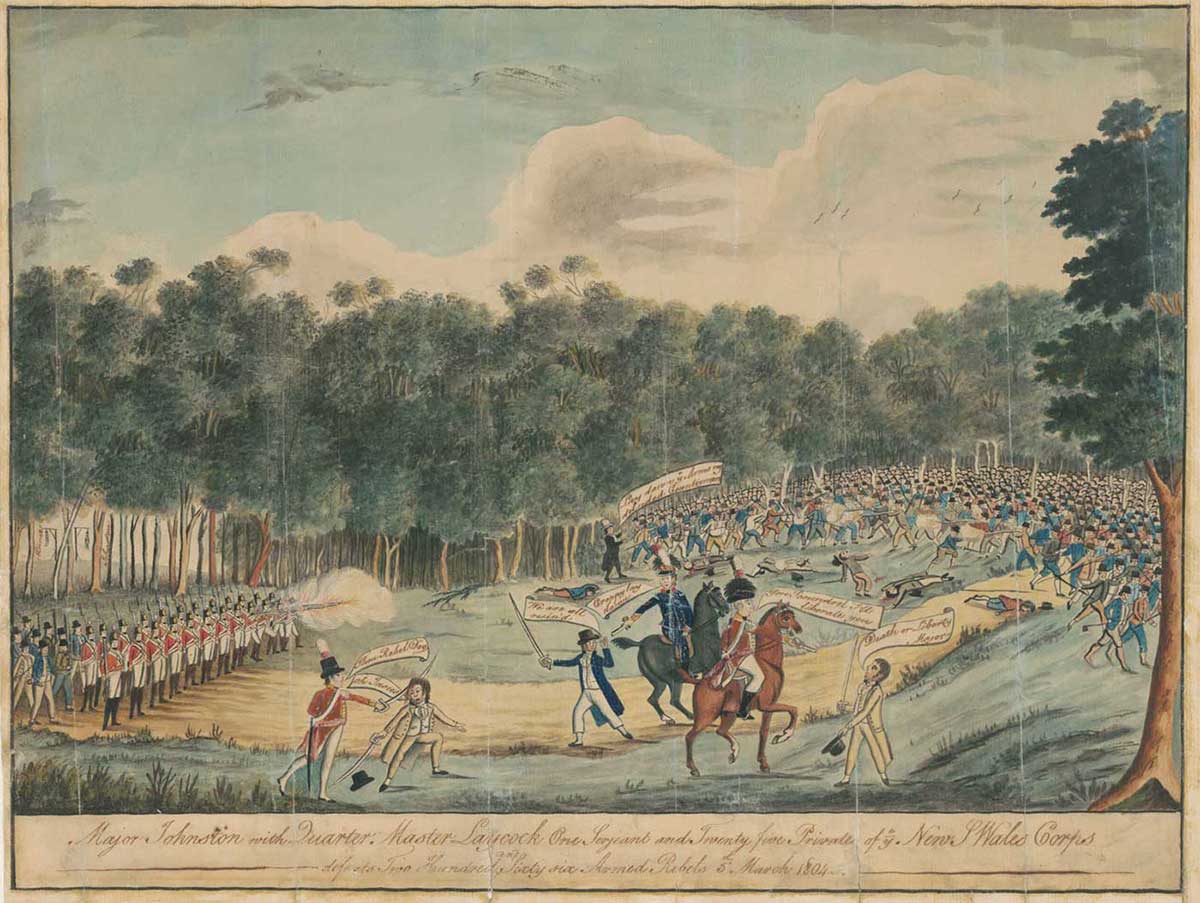
On the evening of 4 March 1804, a hut at Castle Hill was set alight to signal that the uprising had begun. Rebels rallied under the cry “Liberty or Death”, echoing the voices of the Society of United Irishmen. The convicts easily outnumbered and overpowered their guards and seized their weapons. They split into groups and raided nearby farms for ammunition and other supplies. Some men missed the smoke signal or became lost in the dark, leaving the rebel forces smaller than originally planned. The biggest setback came when their key messenger was captured and gave the entire rebel strategy to British forces.
Unaware that the plan had been compromised, Cunningham pressed ahead. The largest group of rebels positioned themselves on Constitution Hill, a strategic lookout with sweeping views of the surrounding area, ready to warn others of any approaching colonial troops.
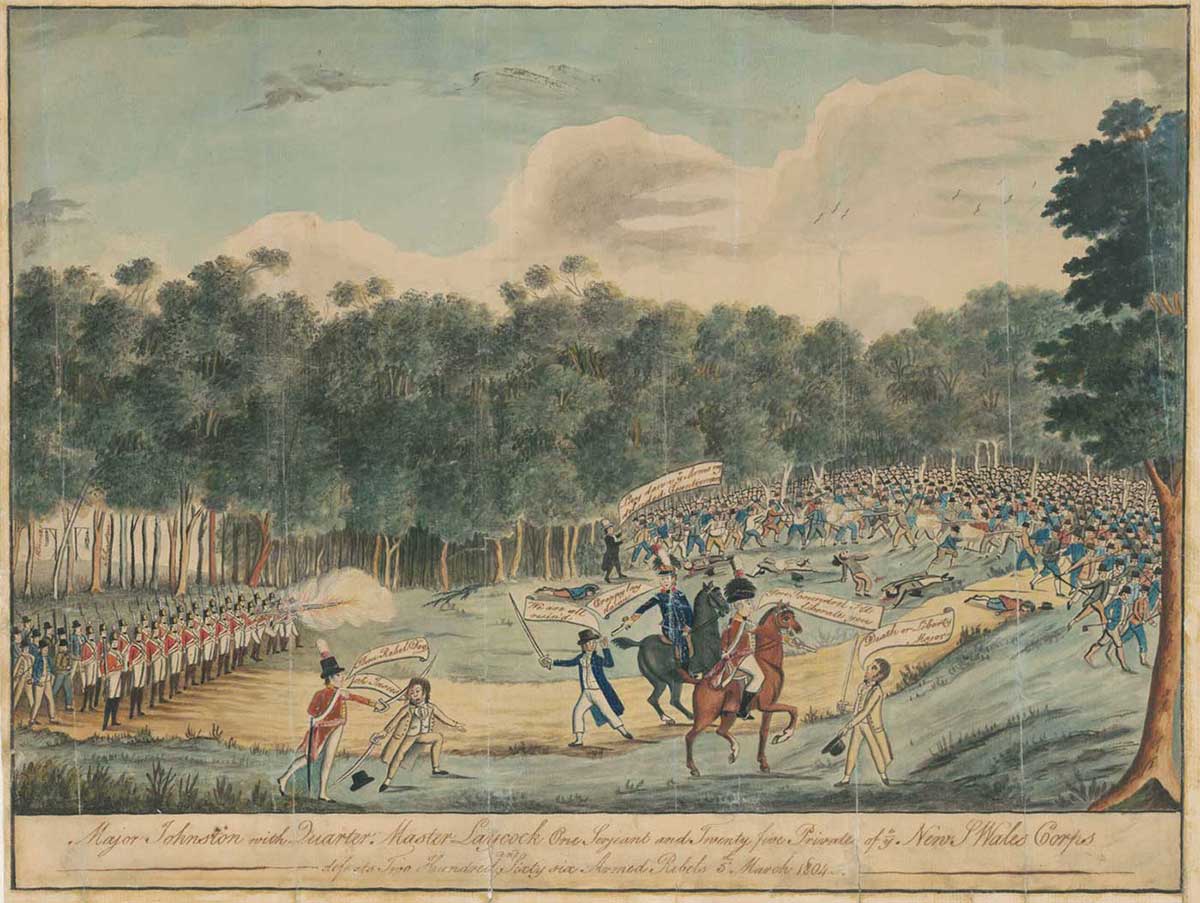
Major George Johnston and Governor King had already begun assembling troops and local militia, declaring martial law across the colony. Major Johnston led British forces travelling overnight toward Constitution Hill, aware of the large rebel group gathered there. By the morning of 5 March, Major Johnston confronted the rebel convicts and said he wanted to avoid bloodshed by negotiating with their commanders. Cunningham attempted to raise a flag of truce, but Major Johnston broke the agreement and swiftly arrested him, along with rebel co-leaders William Johnston and Samuel Humes. Colonial forces then fired and charged, scattering the rebel forces. At least 30 were killed in the day-long crossfire, with no recorded casualties among British troops. Cunningham was publicly hanged during the rebellion, while William Johnston and Samuel Humes were imprisoned alongside more than 60 other rebels. With the execution and imprisonment of its key leaders, the uprising quickly collapsed, but martial law remained in place for over a week to ensure complete suppression.
Punishments for the arrested rebel convicts varied. After their trial, William Johnston and Samuel Humes were executed along with seven other rebels. Over thirty men received hundreds of lashes and were sent to work on the chain gang at Coal River (now known as Newcastle). The remaining convicts stayed at Castle Hill farm but were placed in leg irons, heavy ankle chains permanently fitted by a blacksmith. These irons could weigh anywhere between 3 and 14 kilograms and were worn throughout their regular labour. Punishments like this were common in Australia’s penal system, often serving as visible symbols or reminders to convicts of colonial control.
The Castle Hill Rebellion highlights the trauma of exile, men torn from their homeland, stripped of their rights, and forced into servitude. Living conditions remained harsh in the colonies, particularly for Irish prisoners and their families, who endured systemic mistreatment and discrimination under British rule. For many Irish convicts, life under colonial rule became unbearable, and bushranging felt like their only option. Some of Australia’s most infamous bushrangers, including Ned Kelly, Harry Power, and ‘Bold Jack’ Donohoe, were of Irish descent, shaped by this legacy of Irish resistance.
For decades, Castle Hill was dismissed as a failed mutiny. But modern historians now interpret it as a bold act of anti-colonial resistance. Historian Therese-Marie Meyer argues that it wasn’t merely about escape; it reflected an enduring commitment to the ideals of the United Irishmen. Many of the rebels involved at Castle Hill had earned partial freedom through the ticket-of-leave system yet still risked everything to join the fight. This was far from a simple protest; it represented resistance against British rule. Their actions challenged the colonial narrative of passive convict compliance and control, revealing that political consciousness was unaffected by transportation. Castle Hill stands as a symbol of identity, solidarity, and defiance against imperial domination.
The Castle Hill Rebellion marked a turning point for convict resistance in Australia and became known as ‘Australia’s Vinegar Hill’. It helped shape later acts of resistance, including the Eureka Stockade and the Rum Rebellion. Eureka rebels used ‘Vinegar Hill’ as a secret password during their 1854 rebellion, and “Death or Liberty” became a common phrase used throughout the colonial resistance movement.
As the 19th century progressed, political unrest only intensified among both convicts and free settlers. By 1868, more than 160,000 convicts had been exiled to Australia, and their forced labour fuelled the rapid expansion of colonial infrastructure. Public opinion began to shift against penal transportation, with growing pressure to end convict labour and rising support for national self-governance.
Today, the Rebellion is commemorated at Castle Hill Heritage Park in Sydney. The men who fought during the 1804 rebellion cannot simply be labelled convicts or criminals; they were political prisoners driven by a vision of protecting their homeland. Their story, which was the first major convict uprising in Australia, forms an important chapter in Australia’s penal history.