By Abe Stephanson. Published in Issue 22 of Paper Chained in June 2026.
Author’s note: This piece is offered not as provocation, but as calibration. It invites us—as practitioners, stewards, and witnesses—to reckon with the ethical and developmental stakes of our work. In a climate where political expediency threatens to override evidence and humanity, we must remember: our proximity to harm is not neutral. It is a site of responsibility. May this serve as a mirror, a refusal, and a reminder of what stewardship demands. All feedback – positive or otherwise – is welcome.
In case you missed it, Victorian Premier Jacinta Allan declared: “Courts will treat these children like adults.” With that, Victoria joins Queensland’s ‘adult time for adult crime’ philosophy—an archaic nod to retribution as a response to juvenile crime.
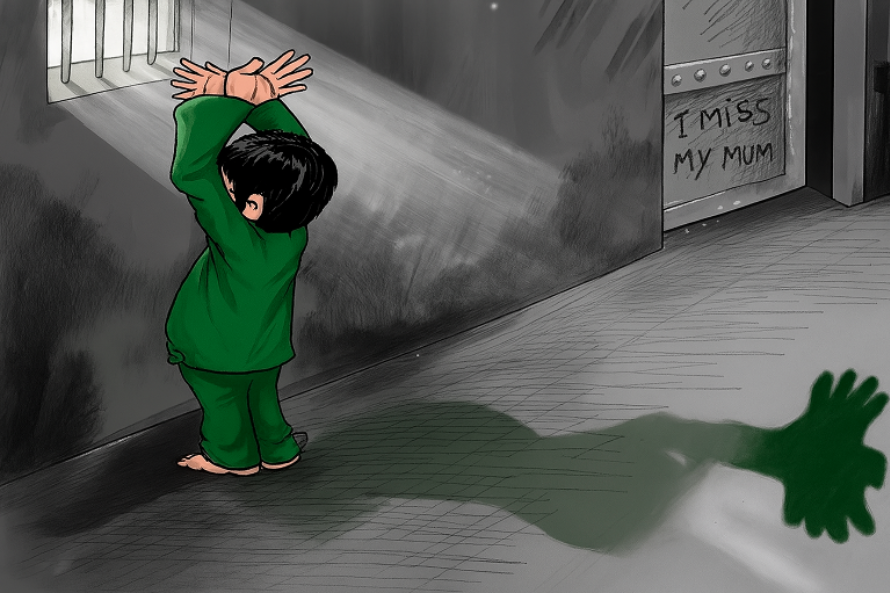
There is a startling admission embedded in both statements: Yes, they are children. And yes, we will judge and punish them as if they are not.
This is not a semantic slip, or error of language—it is a deliberate suspension of developmental truth. An ethical and biological breach.
Children—need the point be laboured—are not adults. Their brains, hearts, and muscles are still forming. Their instincts, understanding, coping, and reasoning capacities are incomplete.
We legislate around this. We build entire systems of protection upon it. We do not let children drive, vote, purchase alcohol or cigarettes, or go to war.
We deny them autonomy for the sake of self-protection. We appropriately criminalise their mistreatment. And yet, when fear surges and headlines beckon, we pretend otherwise—not by accident, but by design.
To pretend a child is an adult is not a neutral legal fiction—it is an abject moral failure. A breach of epistemic integrity—a denial of reality.
A refusal to reckon with what childhood actually means:
Not innocence, but incompletion. Not purity, but potential.
To punish that incompletion as if it were volition is to enact harm under the guise of justice. This is not new.
Beyond the ethical and developmental betrayal, there is the small matter of outcomes: The evidence—abundant, longstanding, and clear—shows youth incarceration is counterproductive.
It does not rehabilitate. It does not deter. It entrenches trauma, compounds disadvantage, and scripts futures of recurrence. It produces more crime, more human misery, more wasted potential. (And yes, it violates the UN Convention on the Rights of the Child—but let’s not get too pedantic.)
It is not a solution. It is a punitive sentence—one that begins before the courtroom and echoes long after release, and far beyond the individual.
And yet, the Victorian government joins Queensland in this choreography of retribution. Not because it lacks data, but because it lacks courage. Not because it misunderstands children, but because it chooses to mis-recognize them. Because it prioritises oversimplification, ignorance, finger-pointing and political expediency over complexity, nuance, shared responsibility and arguably, humanity.
This is not leadership or policy. It is performance. A ritual offering to the shock jocks, the ignorant, the hypocritical, and the vigilante chorus.
A headline masquerading as a solution.
But juvenile crime is not a referendum on morality. It is a mirror—reflecting collective trauma, social neglect, and institutional failure.
To respond with punishment is to smash the mirror and call it repair.
We must refuse this seduction.
We must treat truth as a public good, not a political inconvenience.
And we must plead not-guilty by way of childhood, but responsible by way of stewardship.