By Damien Linnane. Published in Issue 22 of Paper Chained.
The defamation case between Queenslander Karl Jobst and Billy Mitchell from Florida was one of the most epic and infamous legal challenges related to video games the world has ever seen. Chances are you probably haven’t heard of either of these people, who aren’t widely known outside of the video-gaming community.
Mitchell is one of the community’s most controversial figures. He once held an undisputed world record high-score on the 1981 video game Donkey Kong, before evidence emerged in 2018 that his score had not been achieved on an unmodified original Donkey Kong arcade cabinet. There is overwhelming evidence that Mitchell achieved his score on MAME, an emulator that allows games to be played from save states, which allows easy manipulation of scores. Accordingly, a player on MAME must be filmed completing the entire high score to ensure cheating was not used. As Mitchell was not filmed in this way, and as he submitted his record as an arcade score, they were removed from Twin Galaxies, the main source of video-game world records. He remains banned from submitting records to Twin Galaxies.

Jobst’s video-game world-records, by comparison, are uncontested. At one point, he held 199 records for the Nintendo 64 games GoldenEye 007 and Perfect Dark, 16 of which remain to this day. After the peak of his gaming achievements, he went on to become a professional YouTuber and investigative journalist. His channel, which has over a million subscribers, is known for both covering video-game achievements and also exposing video-game cheaters. Jobst extensively covered the evidence that Mitchell not only cheated his high score, but also repeatedly told many falsehoods when speaking about the issue. Jobst was far from alone in doing so.
Video-gaming YouTuber Apollo Legend also released videos stating Mitchell had cheated, after which Mitchell did something he is also famous for; suing people who don’t portray him positively. In 2015, Mitchell lost a lawsuit against Cartoon Network, ironically for their portrayal of a character based on Mitchell in the Regular Show TV series who, among other things, throws tantrums when he doesn’t get his way.
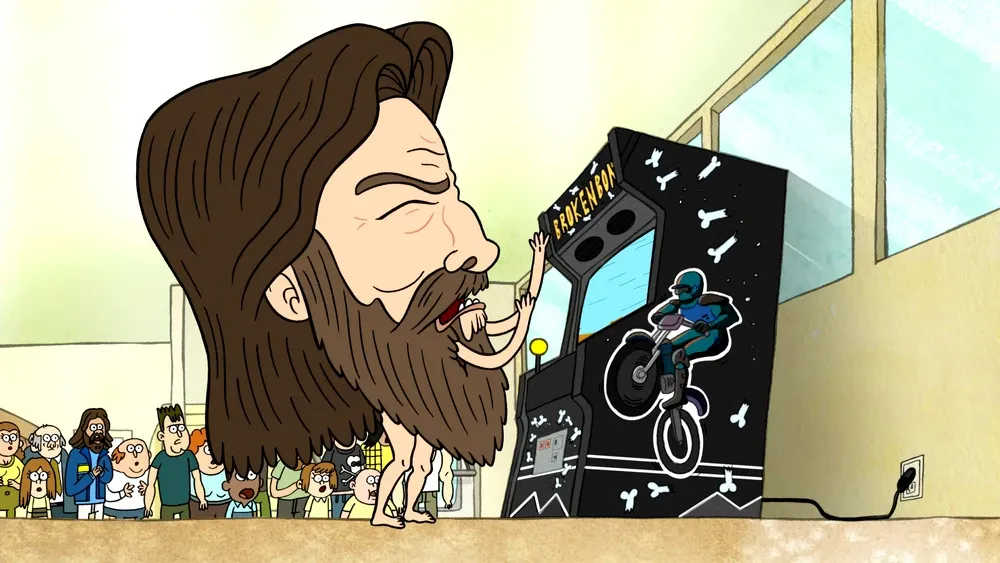
Cartoon Network had more than enough money to fight Mitchell in court and destroy his legal challenge. Apollo Legend did not. Even if he had won, which the evidence suggested he would have, challenging Mitchell in court would have cost Apollo hundreds of thousands of dollars. Apollo, a young man with limited money, backed down to Mitchell’s demands. He settled out of court, and removed his videos on Mitchell from YouTube. Up until that point, Apollo had been earning revenue from the videos. Apollo had existing health issues and died by suicide the following year.
There is no evidence that Apollo’s suicide was related to Mitchell’s lawsuit. However, in his own ongoing coverage of Mitchell, Jobst stated that after the lawsuit was settled, Apollo was left “deeply in debt, which required him to find extra work, but with his ongoing health issues this was all too much of a burden and he ultimately took his own life.” This statement was based on Jobst’s personal interpretation of the matter, rather than any evidence.
Mitchell filed a lawsuit against Jobst for defamation for drawing a connection between his actions and Apollo’s decision to end his own life. Mitchell’s lawyers later sent Jobst’s lawyers concerns notices, informing them that two more lawsuits were going to be filed, one regarding Jobst’s claim that Mitchell cheated his high scores, and another for republishing a meme that also stated Mitchell had cheated. Jobst subsequently released a YouTube video regarding a GoFundMe campaign he started to help raise costs for his legal defence, where he stated the truth; that a lawsuit had been filed against him, and that Mitchell’s lawyers stated that Mitchell intended to file more.
Jobst (left) in the video he uploaded to YouTube explaining that he was sent details of more lawsuits from Mitchell’s lawyers.
In response, Mitchell publicly made incorrect statements that only one legal complaint had ever been made against Jobst, and that Jobst was claiming a second lawsuit had already been filed. Mitchell explicitly stated that any person who had donated to the GoFundMe had done so “based upon a lie”. Mitchell ultimately decided not to file the cases, though Jobst and his lawyers only learned the lawsuits would not be going ahead once the statute of limitations for filing them had expired, by which stage the GoFundMe had closed.
However, the original defamation case proceeded. The case was complex, and the judge accepted some of Jobst's counter arguments, including that Mitchell had an existing reputation as a cheater and that he had also expressed joy when he first learned that Apollo Legend may have died. However, Mitchell ultimately proved successful, with the judge ruling in April 2025 that he had been defamed.
In his ruling, the judge stated Jobst had defamed Mitchell by implying he “caused such stress to Apollo Legend that he decided to end that stress by killing himself. While not directly accusing Mr Mitchell of having murdered Apollo Legend, nor of knowingly encouraging Apollo Legend to kill himself, in one sense it might be seen as almost as serious as such imputations would have been.”
I asked Associate Professor Neil Foster, an expert in defamation law at the University of Newcastle, to explain how rulings like this are reached. “When courts determine if defamation occurred, they will take into account not just what is explicitly said, but what an ordinary reasonable person could conclude from what is said”, says Foster. “The court was satisfied the public would, based on Jobst’s comments, draw an implication between Mitchell and Apollo Legend’s suicide, and Jobst was not able to prove there actually had been a connection.”

After winning the lawsuit, Mitchell contradicted his earlier assertions that Jobst was never sent information on another lawsuit related to cheating in video games. In a video he uploaded to YouTube himself, Mitchell confirmed that details of a second lawsuit were indeed sent to Jobst’s lawyers, though he continued to maintain that the GoFundMe had been a scam on the grounds that Jobst should have somehow been aware the lawsuit was not going to be filed. By this stage, Jobst' reputation was already damaged, due in part to the allegations about his GoFundMe campaign, and he lost over 100,000 followers on YouTube as well as revenue due to decreased views of his videos. While Jobst never lied about the GoFundMe, it should be noted he later apologised for not explaining the fundraiser well enough to his followers, as he had not explicitly clarified Mitchell's original lawsuit was related to Apollo's suicide. Accordingly, many people assumed that lawsuit was also related to cheating accusations. Jobst's reputation also suffered due to this and other factors surrounding the wider lawsuit.
Jobst was ordered to pay Mitchell $350,000 in damages. Both litigating and defending defamation is incredibly expensive, and in Australian law, people who lose lawsuits are almost always ordered to pay a substantial portion of their opponent’s legal fees. Jobst was also ordered to pay over $40,000 interest on the damages from the date he made the defamatory statements, and also pay a significant amount of Mitchell’s legal fees, making his total debt to Mitchell $990,000.
Jobst was unable to pay the damages and instead filed for bankruptcy. Fortunately for Jobst, bankruptcy protections in Australia are robust. When you become bankrupt, all of your debts are absolved, not just the one that caused you to file for bankruptcy. Jobst had about $86,000 in other debts, like credit card bills, which were also wiped. The Australian Financial Security Authority (AFSA) handles bankruptcy applications. A bankrupt person is allowed to keep normal household items, a vehicle worth up to $9,600, work tools or equipment worth up to $4,500, their superannuation, and around two thousand dollars for personal expenses. Any other money is confiscated and other assets are sold. Proceeds from sales of assets are then distributed proportionally to creditors – people the bankrupt person owes money to.
If a person filing for bankruptcy co-owns anything with another person, the AFSA gives that person the option to buy out the share of the jointly owned assets before they attempt to publicly sell them. Jobst co-owned property with his wife, and she made an offer to buy his share of the property, which the AFSA accepted. This is completely legal, though Mitchell publicly claimed that Jobst was engaging in “serious illegal activity before and during this bankruptcy process.”
Jobst raised $224,000 from the liquidation of his assets before he filed for bankruptcy. However, not all of this money went to Mitchell. The AFSA charges fees for their services, beginning at tens of thousands of dollars for even simple bankruptcy cases. This money is deducted before any recovered funds are given to creditors. The AFSA were also obligated to investigate Mitchell’s false claims that Jobst had engaged in illegal activity. While the AFSA concluded Jobst had done nothing wrong, Mitchell likely shot himself in the foot as the investigation probably incurred further costs which were deducted from any money he would receive.
After the AFSA deducted their fees, and money was also given to Jobst’s other creditors, it is estimated that Mitchell received around $150,000. Mitchell’s legal fees were $686,671. Even though he won the lawsuit, he likely walked away from it with over $500,000 in debt.
There are three key points to learn from this spectacular failure from both parties. Firstly, you are asking for trouble if you make libellous claims against someone else without clear evidence, no matter how sure you are right, and no matter how logical the connection seems. It doesn’t matter if there is overwhelming evidence that Mitchell is a cheater and has a long and ongoing history of making incorrect statements. Mitchell’s own credibility is irrelevant to the fact that Jobst had no proof Apollo’s death was related to his behaviour. To Jobst’s credit, he has accepted his failure, and also accepted that he did indeed defame Mitchell, and rightfully calls himself an idiot for doing so.
Secondly, when you sue someone, it’s important to make sure the person you are suing is actually capable of paying any damages you are awarded. Often, the only people who win in defamation lawsuits are the lawyers. As Associate Professor Foster notes, “The nature of civil litigation is that you always run the risk that even if you win, the other person can’t pay. To some extent, Mitchell got the satisfaction of having a verdict in his favour. He may have felt that was significant enough to run the risk, but he’s still going to be out of pocket.”
Bankruptcy law essentially allows a bankrupt person to get on with their lives once the dust settles. Jobst is now essentially debt free and back to earning money by making popular YouTube videos, and has recovered his lost subscribers. Mitchell, however, will never recover the $500,000 he lost by electing to go to court. In addition to being known for having his high-scores removed for cheating, Mitchell will now also be forever remembered by the video-gaming community as the person who managed to lose half a million dollars by winning a lawsuit. But things are getting worse for Mitchell.
The third point is that if someone defames you, that does not give you the right to start defaming that person in response. While researching to write this article, I formed the opinion that Jobst appeared to have a case to sue Mitchell, over his false claims that there had not been a second legal complaint and that Jobst’s GoFundMe was based on a lie, and that Jobst had engaged in illegal activity regarding the sale of the property to his wife. Prior to contacting Jobst, I asked Associate Professor Foster to elaborate on this as well.
“If Mr Mitchell did lie about that, Mr Jobst might be able to sue for the allegation that he’s engaged in a scam for the GoFundMe campaign, when the second legal complaint was real. But there are barriers to suing a person in the United States when you are in a non-US jurisdiction, and unlike Australia, the default is that each party bears their own legal costs even if they win the case,” said Foster.
After I reached out to Jobst requesting an interview in late March 2026, he responded later by pointing out that in early April, he did file a lawsuit against Mitchell in Florida. The best possible outcome for Mitchell is his lawyers successfully applying to have the case dismissed, which would still incur significant legal fees to Mitchell. Jobst has filed the case himself, meaning he has no legal costs yet, though he has indicated he will likely obtain lawyers if the case proceeds to court. A possible outcome is that Mitchell makes him an offer to settle out of court in the meantime. But no matter how this case ends, Mitchell has further increased his debts over the ordeal by making false statements and giving Jobst legitimate grounds to sue him.
Jobst politely declined an interview request as the case is currently open. Mitchell did not respond to a request for comment.