Published in Issue 14 of Paper Chained in June 2024.
Paper Chained Editor Damien Linnane meets with Cara, a sex worker, at a Newcastle cafe to talk about trauma, sex-positivity, and working in the sex industry as a feminist.
So tell me about your job?
I’m a sex worker. There’s a lot of different kinds of sex work, but I work in a regular brothel and I do escorting as well, which means I go out to people’s houses to see them for whatever they might want to explore sexually.
What got you into this work?
So I actually got into it a little bit traumatically. I was raised in South Africa as a Jehovah’s Witness, an organisation that exerts high levels of control over you. I got married at 19. I left my husband because he was very emotionally abusive, and I wanted to be out of that environment as well. But divorce is a big no no when you’re a Jehovah’s Witness. So in leaving him, I was outcast. I was cast out from the community, which cut me off from my parents, my siblings, all my friends that I’d grown up with. Anybody who knew me and would be able to help me was just gone. They were actively shunning me. That put me in a very vulnerable position. I ended up on the street. I started picking up guys and going home with them just because I wanted a shower, a bed, and breakfast.
I was on these pick-up websites to do that, and someone who said they were a woman contacted me online and said: “I like your look, have you done any photo shoots?” And then they asked if I’d tried escorting. I hadn’t, but I felt like that’s basically what I was already doing, just for accommodation rather than money. Anyway this person, they said: “I live in Australia, I have all these businesses and would you like to come and work”. I said yes. When I got to Australia, I found out it wasn’t a woman that I was talking to. It was a really crusty little dude in a shitty Volvo. He picked me up from Sydney Airport and that’s when I realised I was fucked.
So I had spoken to this man who had pretended to be a woman while he was talking to me. He told me I’d be working in Sydney out of apartments and I’d just do escorting, but then he drove me to Canberra and it was just a shitty brothel and we weren’t allowed to leave. So that was my start to the industry, and I had to learn very quickly how everything worked. I spent about 3 months in that environment until I started figuring out that this isn’t normal for the industry. It’s not normal for your employer to expect you to give him free services. It’s not normal for these prices and restrictions they put on us. So my start was as a survival worker, but even in that space, I enjoyed the camaraderie of it. I enjoyed the puzzle of human contact, meeting someone very quickly and having to figure out what they’re into, what makes them tick, and then leave them feeling happy and having what experience they wanted.
I feel like there’s a stereotype that a lot of people come to sex work from trauma. Do you think that’s true?
My story isn’t a normal story. I think that stereotype is a media thing. In media, because of the moralising around the actual act of sex, sex workers are always portrayed as a victim or as someone who doesn’t care about themselves. There’s no legitimate in-between.
My story definitely stems from my personal circumstances, but there’s a lot of workers that just do it because they got bored of their day job or they wanted a side hustle, or they saw a friend doing it and it looked like fun. I don’t think that all sex workers have trauma. It’s not a prerequisite. It definitely happens, but that happens for every human in every industry.
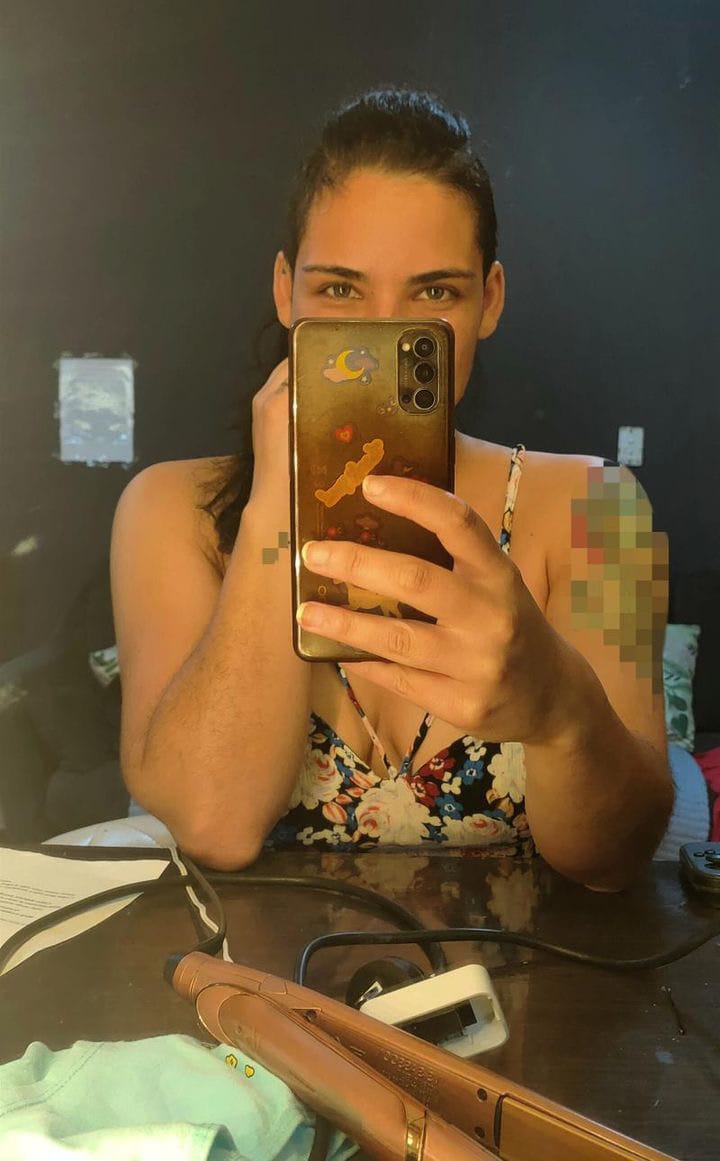
Are most people happy where you work now?
Yeah. I can definitely say that if there are people coming out of trauma, the staff at work have done a lot to assist them instead of just being like, “Work and sort it out yourself.” There’s a big mix of ages and backgrounds where I work. There are people touring from overseas.
Recently there was a case of a very young worker who came from an abusive, traumatic background and was there for survival like I had been. They gave her accommodation in the space, helped her find temporary foster homes for her animals, and told her to just jump on a shift when she could. With the nature of the industry, you’re always going to see people from traumatised backgrounds coming in.
How long have you considered yourself a feminist?
So having this very religious conservative background, I didn’t get words for feminism. Even in the publications that the Jehovah’s Witnesses published, I remember very strongly an article that was read in the church where it was saying that “Women’s liberty is destroying the family unit. You should be a wife.” And I remember just feeling at odds with that from like eleven years old.
The reason I got married at nineteen was because I wanted to run my own home. And in that particular environment, I’m either my father’s daughter or my husband’s wife. I’m never my own person. I can definitely say from my teens I felt that I’ve had a strong sense of not wanting to be boxed into “This is woman,” and that feeds into my gender identity today as well. But that’s what sparked my interest in feminism and feminist icons, being at odds with what was expected of me as a girl child.
It was frustrating, because I’m a good speaker and I won awards at school for public speaking. But I wasn’t allowed to speak in the church because I have a vagina. I would sit there and get so frustrated listening to the men and the boys in my community stuttering and struggling to deliver their talks and speeches.
I feel like there’s still a stereotype that all feminists are against the sex industry.
There’s an interesting divide there. There’s a type of feminist called SWERFS, Sex Worker Exclusionary Radical Feminists, who believe that you cannot participate in the industry without being exploited, and there is indeed definitely an element of exploitation to the industry. There’s definitely a power imbalance. NSW has some of the most progressive sex work laws in the world, but there’s still a power imbalance between establishment owners and workers. There’s still a power imbalance between private workers and their clients because there’s a power imbalance between men and women.
But I don’t think feminism and sex work are mutually exclusive. There are definitely workers, even in my immediate space, who are not feminists. There are definitely workers who are racist and trans-phobic and those who look down on other workers for their choices. There’s a hierarchy within sex work, where street workers, brothel workers and private escorts all see each other differently, strippers and topless waitresses see each other differently, so do workers doing Only Fans and content. There’s not always a mutual respect.
So with all of those divides existing, there’s always going to be an element of bullying and anti-feminist ideas. I think at the core of it, my personal belief, in the way I sit with it, is that sex work is work. I see it like any other job. I’m not going to say flipping hamburgers is feminist. I’m not going to say working in a hair salon is feminist. I don’t think the act of being a sex worker is feminist in of itself. But at the same time, being in charge of your own sexuality, being comfortable and having ownership of your body in the way you’re using it, makes it not an anti-feminist thing to do. I don’t feel like we’re working against what feminism is trying to do for women.
My history with sex work has trauma in it. And one of the groups that said they wanted to help me are advocates of the Nordic model. The Nordic model criminalises the purchasing of sexual services, but not the selling of it. And in that way they’re hoping to eliminate the industry. The problem with that is that the industry has always existed and it’s going to continue to exist and the Nordic model just makes it more dangerous. It’s difficult to report people if an element of it is criminalised. So the Nordic model kind of looks at all sex workers as victims, no matter how you got into it. Advocates for models like this are often attached to religious organisations. I reached out to one faith-based organisation, Pink Cross, who said they would help me. But then private phone records and emails between me and them were given to the defence lawyer of the man who trafficked me, without my consent. I told Pink Cross I was worried about getting deported if I reported the man, and then that information I gave them was used against me in court. So talking to them just left me worse off.
So the ways these organisations try to “help” sex workers is by rehabilitation. So even if you’re really happy doing it, they’re basically advocating for conversion therapy, to convince you that you’re not happy and you need help. So at their heart, they’re really not trying to help the individual worker. They’re pushing their moral view on the world, which is not feminist. The whole point of feminism is equality. So if someone really wants to do sex work, you should support them. At the end of the day, it’s important to advocate for safety, and shaming people for working isn’t going to help with that.
In my personal circle of co-workers, there are definitely people who are outwardly very not feminist and declare that they don’t understand feminism. But if you’re doing sex work, it’s more likely that you’re sex-positive. It’s more likely that you have a pretty strong sense of self. So I would say that in my experience, and specifically in Australia, sex workers trend towards having strong feminist ideas. The people who are definitely not feminist or actively speak against feminism are by far a small minority.
What’s your definition of sex-positive?
My definition of sex-positive is education. So if you want to practice abstinence and or want monogamy and to be with one person, or even if you’re asexual or demisexual, that’s sex positive because you’re educated. You know that about yourself, and you know that people with other needs and expressions exist. I don’t think sex positivity means engaging in a lot of sex, because the human experience is so varied. That’s just not what everyone wants.
Being sex positive is about educating yourself about the very broad experience that we call sex, and about the nuances and power balances that exist within those structures.
So not that you’re having a lot of sex, but that you think sexuality is not something to be ashamed of?
Yes. It’s about understanding your own body and your own sexual needs and responses. That, for me, is sex positivity and that’s absolutely lacking across both genders. One of the questions I ask in a booking is “How do you like to be touched?” And the number of men that cannot answer that question is astounding. And that’s coming from the gender that’s supposed to have more sexual freedom. So sex positivity is definitely not having a lot of sex. But knowing what you like, and knowing how to ask that from someone else, and understanding the difference between your personal experience and your needs and someone else’s that might be the polar opposite of you.
Outside work, have you ever come across other feminists who have a problem with your job?
Yeah, definitely. I’m pretty vocal about what I do. I’m pretty forward about my sexuality and I think my contribution to feminism and the women around me is to speak very candidly about my own sexual experiences, my body and my job, because some people just need that permission to talk about their experiences and women don’t often get that. I’ve definitely had situations with people who say that I am putting the feminist movement back or, that I shouldn’t “allow” men to control me that way.
And again, I think a lot of the conflict between sex work and feminism comes from the moralising of the sex act itself. It comes from having a black and white, right or wrong concept of having sex with a stranger. It will often be the case with these women who are criticising me that they’re on Tinder going out having one-night stands. But they view that as different to what I do. It’s not that different. If I’m going out and expecting someone to buy me a bunch of drinks or dinner or take me on several dates, versus just accepting them giving me $200, what’s the difference between me and you? I’m just cutting out a few steps and getting paid for it. [Laughs]
At the end of the day, all sexual interactions are transactional. And it’s kind of a cold way to say it, but at the heart of it, if you are engaging in that level of intimacy with someone, it’s an exchange. And that might be an exchange for comfort, for reassurance that they care about you in a certain way. It might be an exchange for money. It might be an exchange for dopamine. But sex is always a transaction, even if you’re not actively aware of it, you’re always trading something to get to that point. It might just be emotional support. There are plenty of couples where there’s either a libido imbalance, or one partner isn’t that excited by the prospect of having sex with them. But there’s an emotional tie. So they have sex to keep the emotional tie.
I can’t help but notice your legs aren’t shaved. Do customers ever give you shit for that?
Oh yeah, it’s very interesting. So I’m pan-sexual and gender fluid. My gender identity swings pretty wildly between masculine and feminine, but when I’m working, I work as a woman. When I first started, I groomed myself to be as womanly as I could be. I don’t in my real life present as very feminine. But when I started, I put a lot of work into getting rid of all my hair and doing my make-up. And I wore wigs to cover the shaved sides of my head. And I thought, well, everybody has different tastes, and honestly, the more I worked, the more I saw the variety in bodies and presentations. Eventually I switched over to something more comfortable for me. Now I go out to meet my clients in crop T-shirts. And I don’t shave as much and I kind of do what I want. Every now and again I’ll get someone who will make a comment and I usually just make a joke out of it. They’ll be like, “Oh, you’ve got hairy legs.” And I’m like, “Yeah I grew it myself.”
I had someone tell me that they liked that I was always myself when they booked me. And after our working relationship ended, he turned around and sent a bunch of messages about my body hair and my presentation, saying that I’m too masculine and I should shave my armpits. All his own insecurities came out. There’s a very strange relationship between humans and body hair, I guess. I have to navigate in that space. But I’ve actually turned it into a specialty. So on my adverts I state that I don’t shave. I do specifically get people who will book me for my leg hair, and for actually having pubes.
Do you have a particular funny story about a job?
Oh God, so many. [Laughs] I think most of my funny stories just come around from requests. Someone once wanted me to do a Christmas role play with them. They wanted me to be an elf and they were Santa. They even had Christmas music playing in the background. It was difficult because they were very young, and I think trying to keep it together while bouncing on top of them, singing Jingle Bells and making it sexy was definitely an experience I won’t forget.
I assume this costs extra?
[Laughs] Yeah, if you want me to sing Jingle Bells while I’m riding you, I’ll do it. But we have to talk about it first.
Are there any bad experiences you’d like to share?
My coming into the industry with all the trauma is the worst experience I’ve had. Since then, as I’ve gotten more confident in myself and done more research into the industry and found my place in it, I’m a lot better at advocating for myself. So I’m having fewer bad experiences because I’m shutting them down long before they can happen. I recognise toxic clients. There’s definitely this mindset among some sex workers that, “Oh well, he’s paid me for a service. I need to pander to this person.” Whereas I definitely have the view that you’re paying for access, but I can shut down that access at any time. But even for myself, as outspoken as I am, I still have situations where it’s very hard for me to stop the booking and be like, “Hey, what you’re doing is hurting me. You need to get off me.”
Some clients have a sense of entitlement, thinking they can do whatever they want to you because you’re a worker, but it often goes two ways with male clients. They will either be like, “You clearly have no regard for your own body,” or they will be like, “Are you OK? I want you to come live with me; I can look after you.” I call them the “Captain Save-A-Ho’s.” They just want their ego stroked at the end of the day. But those two extremes, again, it comes back down to media representation of sex workers. We’re either completely helpless or we don’t give any fucks about ourselves and have no standards.
Since I re-entered the industry on purpose, with my own feet, I am definitely much better at spotting problem people. Sometimes I won’t even take the job. I’ll introduce myself to them in the booking room at work, and then I’ll tell reception straight away that I won’t take that booking. The more solid idea you have about why you’re doing the job and for what goals you have for the job, the easier it is to deal with those problems. It’s kind of obvious when bad clients come in. They look at you like a product instead of as a person.
I’ve given this advice to a lot of friends who are just starting out in the industry: never tell a client that you’re new, say you’re touring or you’ve come back after a while. Because there are men who will specifically book a new worker because they think you will have no boundaries and no idea what’s acceptable and what’s not, and they can get away with more for free or stuff that just wouldn’t be right. I definitely have had men who will speak very degradingly to me during sex, and I’ll say ‘You didn’t pay for that. Like we can do degradation. But that’s an extra, right?’
It’s strange that they have that sense of entitlement in the first place, but men who behave that way towards workers behave that way towards all women. Men who hate women, they still have relationships, they have mothers and sisters and girlfriends and wives, but they don’t actually like women. I think the way that a man behaves towards a sex worker is very indicative of their attitude towards women in general. You’re not going to say and do those things out of the blue. That’s already in your mind and you think you have permission to do it now. It’s a bit icky sometimes, but I can honestly say by and large those encounters are in the minority.
With the younger generation being a bit more sex positive and a bit more educated, I’m noticing a different approach and attitude though. Men in their 30s and younger are more aware of what the industry is, and approach me as a service provider, not as just a hole. There are definitely less problems than there used to be.
When somebody pays extra to degrade you, do you actually feel degraded?
No, because there’s been an exchange. It’s only an element of role play. Where I feel there’s boundary pushing is when people are trying to touch me before we even get to the room. They’ll be like slapping my butt or saying things to me as we’re walking up the corridor in front of everyone.
I will pull people up, but that’s a problem in society in general. There’s definitely a lack of willingness in a regular sexual encounter to pull a man up on their behaviour in the bedroom. If you’re in a sexual encounter with a man and you say, “I want to stop” or “I don’t like how you’re doing that”, a lot of men can take that very personally and that can go one way or the other. Or they just don’t listen.
My generation didn’t get taught much about consent in school. All I was taught was that “No means no”, and so up until my early twenties, I would make assertive moves on women, and if the woman said “No”, I would stop. And I thought I was really great with consent because I was doing everything I’d been taught. I’m embarrassed about this now, but it never occurred to me at the time that maybe the only reason a woman doesn’t say “No” is because she’s not confident enough to say “No”.
Yeah, it’s a journey. But that’s so pervasive and not specific to sex. What’s happening during sex is symptomatic of the larger gender imbalance, even in situations with like medical professionals it’s hard to communicate consent. It’s a two-sided thing because men and boys aren’t taught how to communicate consent in a sexual experience, and women and girls are taught to be passive and taught to not be assertive in that sense because then you’re a slut and domineering or whatever. So you don’t learn what your body likes, so it’s hard to be say “I don’t really like that” because you don’t know for yourself a lot of the time.
I wish I’d been taught active consent in school. Can you explain to our readers what that term means to you?
Active consent for me is verbal consent. Making sure someone says “Yes” first, rather than waiting for them to say no. I need words from people and it also has to be enthusiastic. There cannot be a question mark in the “Yes” at all. A lot of it you have to take on yourself. You have to be a good body language reader. That is sometimes a bit tough for me, as I find it difficult to read body language sometimes. But active consent is verbal and sometimes people can think that’s a bit unsexy. But there’s definitely a way to do it that is super-hot. Like if you start doing something it doesn’t have to be a question. I personally find it very overwhelming with people who are learning active consent and they keep asking me, “Are you OK?” or “Can I do this?” or “Is it OK if I do that?” That immediately puts me in a state of unease.
A good approach is instead saying, “I would really love to kiss you right now”, and then if you get that move towards you and that act of consent in that, you keep going. Or like saying, “Your body’s so beautiful, I’d love to touch you.” Those kinds of things, they can be really sensual and intimate and gorgeous. If you keep checking in that way, and making it more about what you’re seeing and feeling, it takes that pressure off a partner of instead of just asking “Give me a Yes or No.”
If it’s not an enthusiastic “Yes”, it’s a “No”.
Yeah, absolutely. As humans, our survival relies on social cues and being able to interact with other humans. I think, people know when it’s a bit nervous or a bit of a “No”, and you kind of have to be okay with pulling back.
Tell me about other types of clients you get.
I get couples bookings as well. If I’m seeing a straight couple, I put in a lot of effort to make sure that I have enthusiastic consent from the female partner. I have turned couples away because I can see how uncomfortable the woman is. Sometimes they’ve been pressured into the booking by their partner. You can see like the pleading in their eyes that they don’t want to be there.
Probably a big portion of my clientele have come out of prison. I will get people who are “repeat offenders” coming to me. [Laughs] They’ll come to me with their friendship bracelets still around their ankles and will tell me I’m their first stop after getting out, and then they’ll ask me if there is an Orthodox Church somewhere. Because they need to go there next. It’s part of the circle. It’s okay to need touch and it’s okay to come in and do that. But be aware that that’s what it is. It’s the same with the Air Force guys here. They’ll come in to lose their virginity, and they’re green around the ears and they’re 19 or 20 and they’re joining the military because they want to leave home. And there’s all this pressure. And I’ll say, it’s OK to need touch and it’s OK to not know what you’re doing. It doesn’t have to be an exploit. It’s OK to let me look after you.
With guys who have just come out of prison, is the experience different because they haven’t been with someone in a long time?
Honestly my clients that have just gotten out of prison are some of my loveliest clients’, like the nicest, and best bookings that I have. I love them. Because they just want to have a nice time. They want cuddles. They miss human touch. And often it’ll be very quick. But I always look forward to it. And sometimes there’s a bit of embarrassment. Like, they won’t always tell me they just got out. But sometimes you just know.
My experience of Australian men has been very interesting because I didn’t grow up here, so I didn’t grow up with being exposed to the way that Australian men interact with each other and interact with women. And it’s very different from what I know. A lot of my clientele are absolutely touch deprived. Truckies and miners and older men who’ve lost their spouses. They’re absolutely not lonely because they have friendships, but they don’t get touched. Like their mates aren’t sitting and having D and M’s with them, or not when they’re sober anyway. They’re not giving each other hugs. They’re not sitting close on the sofa. They’re not getting what they need from their male friends. They’re not getting it from their parents because you don’t treat your male children that way.
So the only context that a lot of Australian men are receiving emotional intimacy and cuddles is during and after sex. Men will often have an emotional breakdown with me in a sexual context because they’re holding on to all of this need for human touch, and that’s when their body is conditioned to be emotional. It’s very interesting to me. I would honestly argue that 90% of my job is an emotional support thing and not about the sex.
Do you ever get female clients on their own?
Yeah. A lot less often, but it happens.
I’m probably pandering to stereotypes, but I thought women would find it easier to pick up women.
Yes and no. It’s a lot easier for women to get transactional sex. It’s hard to get good sex. You’re gambling every time. And honestly, with men more often than not you’re only going to be semi-satisfied, and then have to get yourself off the rest of the way. That’s just how it is.
I see sex workers myself occasionally, and the reasons I go and see a sex worker is either because I want an experience that I would need a partner that I trust very deeply to do, or because they offer an experience that my partners aren’t into. I’m not going to pressure my partners to do something sexually that doesn’t bring them joy. I’m going to go get that somewhere else. Or because I want to be with a woman and picking up women is hard. Not just for men, it’s hard for everybody. I honestly believe this is not down to women being fussier or anything like that. It’s a societal expectation of how you’re allowed to put yourself out, how forward you can be with your sexuality and the kind of the permissions we give ourselves.
Is there anything else you wish men would understand before they came to a brothel?
The biggest thing is we’re service providers, just like a hairdresser. We’re not products, you’re not purchasing a thing that you get to use and then discard. Paying someone for sex is no different from paying someone to give you a haircut or repair your car, that’s the category we’re in. Come in with that attitude, and come in with the knowledge that we’re professionals. We have our client’s safety at heart as well. There’s definitely another stereotype that sex workers are just trying to extract every penny and do as little as possible for as much money. Unfortunately some workers have that attitude, but by and large that’s not normal. Just come in understanding that we are a service industry.