By Damien Linnane. Published in Issue 11 of Paper Chained in September 2023.
It’s the day before the Cure Conference is set to begin in Nairobi, Kenya, and I’m sightseeing at the National Museum. In the museum’s gallery, I notice a striking painting of a prisoner working underneath a truck, under the watchful eye of guards. ‘Mechanic Prisoner’ the piece is called, by James Mutugi, a former prisoner. ‘I want to tell the stories that die inside the walls of prison that would otherwise not have emerged to reach out to ex-convicts to heal’, James’ profile next to his painting reads. His Instagram handle is provided, and I send him a message.
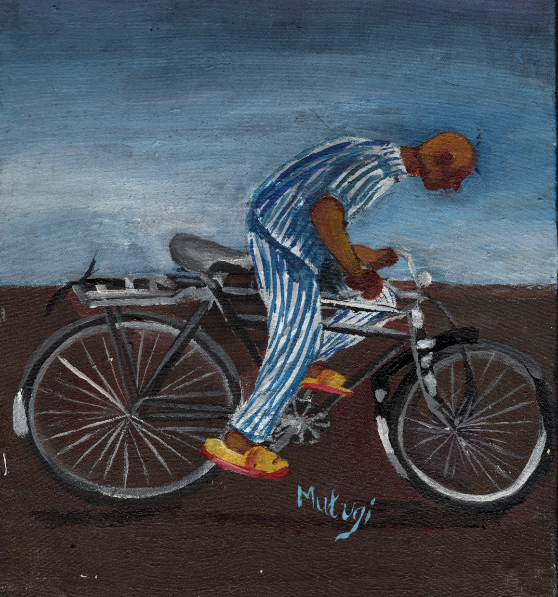
James meets me at the museum’s cafe. He brings a huge smile and a package of paintings with him. Some are of Kenyan wildlife, but not surprisingly, many are prison-themed. ‘This one is an escapee’, he tells me, referring to a man in ’Zebra’ the standard Kenyan pinstripe prison uniform. ‘He is on a bicycle and he doesn’t know where he’s going, but freedom is better than silver and gold. The painting is called Escaping’.
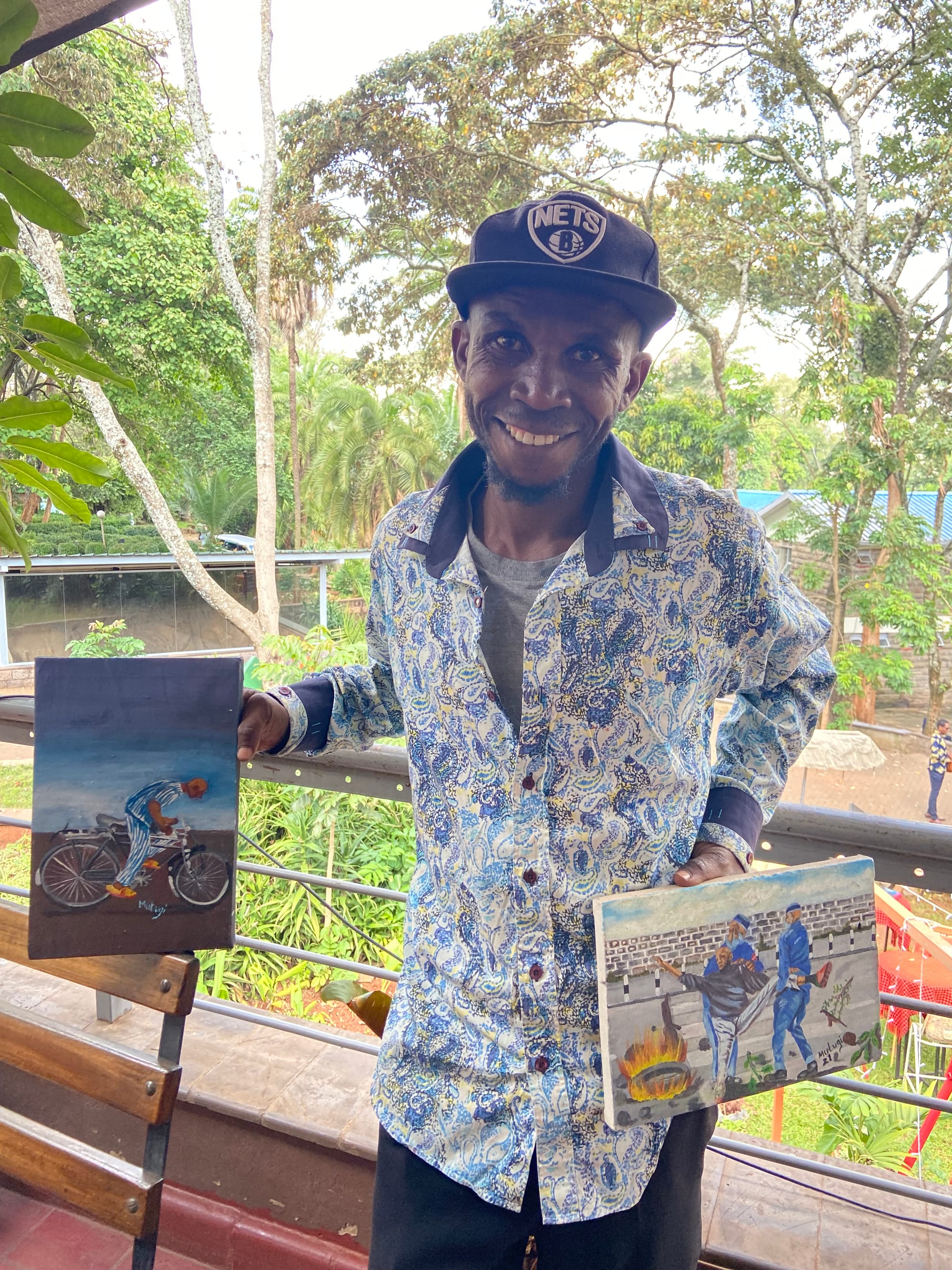
I’ve never been quite so keen to buy a painting, immediately knowing it’s going to be the cover art for our next issue. James tells me his story over lunch. ‘I went to prison in 2008’, he says, telling me he committed a minor robbery. ‘But the police officer said that I had a knife, which was fiction, so [the charge] became robbery violence section 296. If I was found guilty I could be sentenced to hanging, but the case went well and I was sentenced to 10 years.’
Corruption is high in Kenya. As I saw myself, police will ask for bribes just to allow you to continue down the street you were driving on. The more serious charges the police can bring, the earlier they are eligible for promotion. I’m amazed James considers 10 years for minor theft to be a positive outcome, though I remind myself that half the people in prison here are serving life-sentences for crimes that would only attract the punishment of a few years in Australia. It’s my first time on the African continent, and while some areas are affluent and don’t look much different from home, the poverty and desperation of many people is often in plain sight, and also reflected in James’ art.
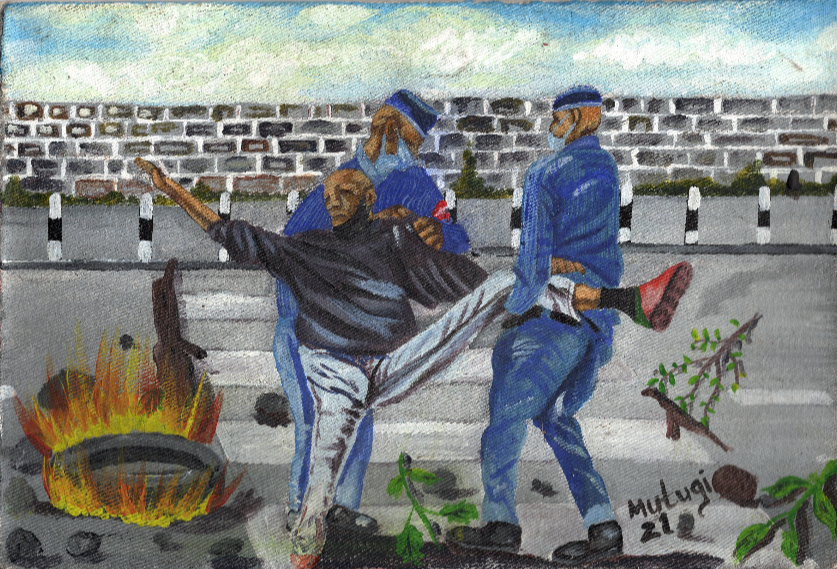
‘This one is of someone resisting the police and protesting due to the high cost of food’, James continues, showing me a painting of two police officers in blue dragging another man away. ‘One of my friends was demonstrating and was caught by the police.’
James has had a long history of making art, and surviving poverty. As a child he lived on the streets after his parents separated, but was taken into a missionary centre, where he began drawing at the age of nine. He won an art award in 1995, and used the proceeds to pay for his own high school education after he left the centre to live with his aunt. ‘Life became harder then’, he tells me, ‘I started snatching things from people because I could not bring myself to tell my aunt I needed things.’ James eventually went to live on his own, and got his first job as an office messenger.
‘The job was not in my heart because I didn’t love it, I loved painting. I didn’t do anything wrong at my job, but payment was slow and there was no annual increments [in pay], so I left and started taking people’s things by robbery instead.’ After he was caught, he was sent to Kamiti Maximum Security Prison.
I’m keen to hear first-hand what the conditions in Kenyan prisons are like, and James is happy to talk. ‘There might be 13 people in a room made for six. Maybe you get a rug in prison, and you sleep on the rug. If you have money, you can buy a mattress. There are no toilets, only buckets. You get porridge in the morning, maybe this size’, he tells me, pointing to a small round salt-shaker on the table. ‘For lunch they will give you a bit of flour and warm water. For dinner, you get a few beans. They served the beans to us on a palette knife, like they use in masonry. This is not good, the beans drop everywhere.’ He mimics the ordeal with his hands and we can’t help but laugh at the absurdity.
‘There are problems between the prisoners and guards. The guards make maybe 10-15,000 Kenyan shillings a month ($110-165 Australian dollars). How can you live on that if you have five children? The guards don’t live in good places and they are often angry. Most of them are not friendly.’
While there’s clearly some disparity between our prison systems, some things sound disturbingly familiar. ‘Healthcare is not good, they do not care. Any problem you have, they just give you aspirin. They don’t give you the right treatment to fix the problem. There is no time for psychological treatment or counselling. They only want you to work.’
I’m reminded of my own time inside, where paracetamol was the only thing given to me for 10 weeks of a severe toothache, and where I worked six days a week in a sawmill, though was denied mental health treatment despite repeated requests for it. Unfortunately I learn things are considerably worse for Kenyan prisoners after James shows me his next painting. It is of a prisoner who has climbed up a lamp post. I have to ask what is going on.
‘This was someone at my prison who had an ulcer, but the doctor would not help him’, James tells me. ‘He has climbed up the post to attract the attention of the prison warder. He needs to draw attention to himself, otherwise he will just be ignored. The prison nurses or doctors aren’t interested in helping him, but he hopes maybe the prison warder will take him to the national hospital. I paid 1,000 shillings ($11) to be taken to the hospital myself once. If you have money, you can get good healthcare, you can get anything.’
Despite a lack of many basic resources, art supplies at the prison were available for a time, but not because the prison provided any. Supplies were provided by the Faraja Trust, a local charity, and James introduced painting to many other prisoners. After about three years inside, James became the first prisoner at Kamiti to paint murals on the walls. Since his release, Faraja Trust has paid him to go back into Kamiti to make more murals. There was no pay for his work while he was incarcerated. We share a joke about the irony that he is now paid to go back and add to the murals he worked on for free while incarcerated.
Painting is now James’ full-time job. ‘The only days I don’t paint is when I’m going to other people’s exhibitions to learn new styles. My advice for people wanting to paint is not to think about the money or how you will sell something. Don’t worry about the market, worry about materials. Once you get materials, work slowly so that you do something beautiful that has a message for people. If the message is good, people will come from all over to meet you, even from other countries,’ he smiles. I ask him where his art will take him next.
‘I’m about to start a series about the slums here. A lack of job opportunities leads to people living in the slum, where there is crime and prostitution and poverty. I was born in the slum, but I’m painting prison because I have lived there too. Now I want to start a series about the slum. Everything from how people drink in the slums, work in the slums, bring bread and food in on bicycles and motorbikes. How the rivers are polluted. Prisons and slums are both my stories and I want to share them.’
‘I’m also planning to volunteer to teach art in prison as well, but that is very expensive. The prison does not provide materials, I have to bring them.’ As we part ways after lunch I’m again reminded of the things we take for granted in Australia, even in prison, and I hope I can find a way to help James bring art to more incarcerated people in Kenya.
James is on Instagram @wangechijamesmutugi. Please get in touch to buy a painting or donate money for art supplies in Kenyan prisons.