By Damien Linnane. Published in Issue 19 of Paper Chained in September 2025.
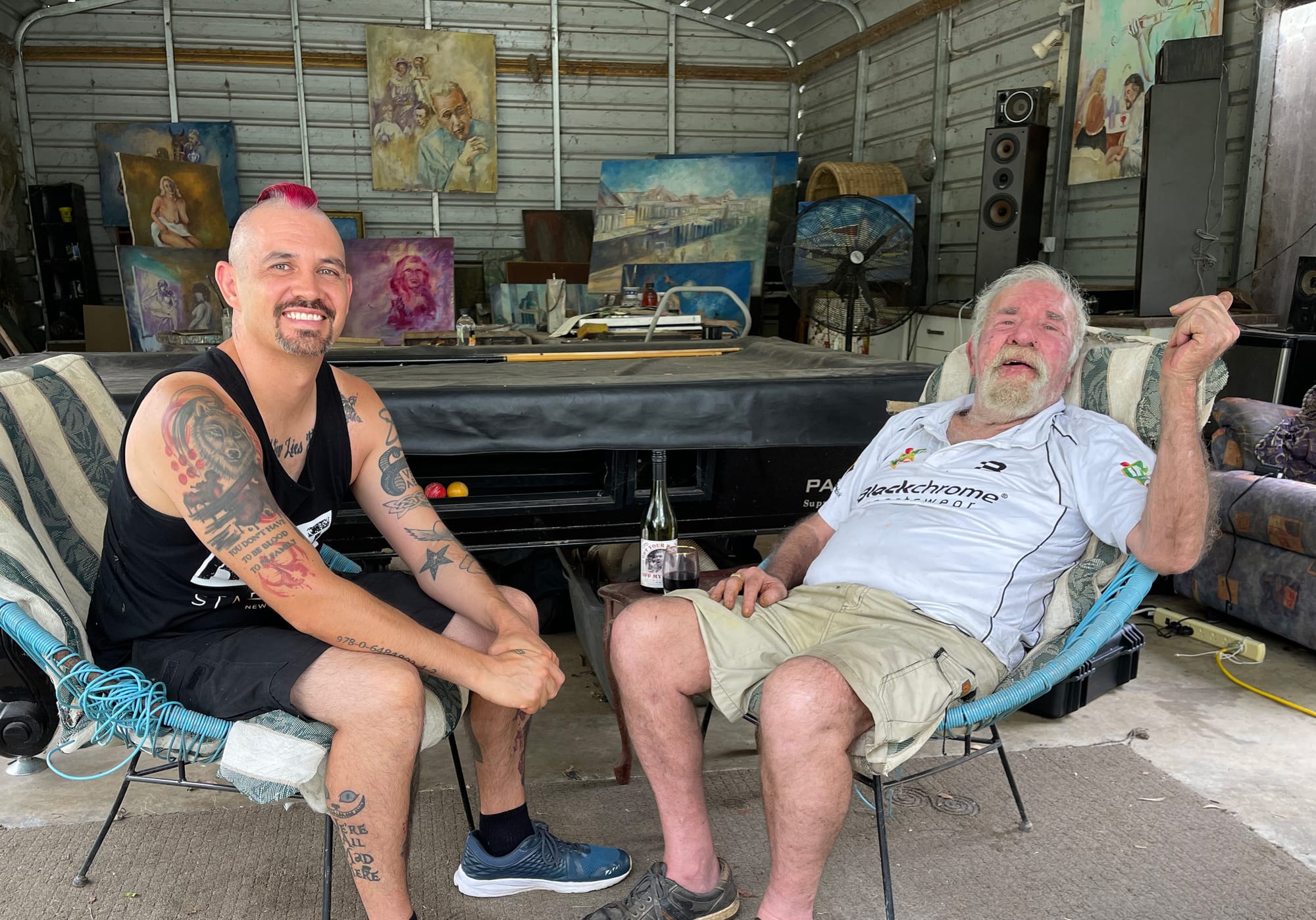
Jack Karlson was quite the character, but of course I’d already known that before driving out to visit him at his home in Mt. Hallen, Queensland last year. Among other things, I’m here to talk to Jack about art in prison, as part of an upcoming documentary film I’ve been working on. The director sets up our microphones and does a standard sound check, asking a random question. “What did you guys have for breakfast?,” she asks. “I had muesli and a banana,” I reply. “I had vodka,” says Jack. I don’t think he’s joking. When I asked whether we could come out and film, and whether I could bring him anything for morning tea, he only asked me to bring him “a bottle of the red grape.” I brought two. It’s 10am, and I was expecting him to save them for later, but he opens one and pours himself a glass. I decline his offer of a glass myself, and decide that I best start asking my questions sooner rather than later.
Most people know Jack for the viral video of his 1991 arrest outside a Chinese restaurant in Brisbane. Surrounded by police, Jack exclaims, “Gentleman, this is democracy manifest.” Protesting his arrest, he then spoke his now-famous words, “What is the charge? Eating a meal? A succulent Chinese meal?” The arrest was only filmed as Jack had been mistakenly identified as a ‘most-wanted’ criminal. What most people don’t know about Jack is that his journey towards becoming an artist in prison began in the 1960s, when he was in Long Bay for safe-cracking.
Jack's viral arrest video.
“I first picked up my paintbrush in Long Bay Gaol,” Jack tells me. His friend Billy Finch was a painter. “And [Billy] said to me, ‘Mate, they got you down to be transferred to Grafton’ when the visiting justice, Murray Farquhar, arrives. Murray loved painting. Billy said, ‘What you got to do, I do paintings and I’ll bring a couple up to you when he comes in here to you, take this painting in.’ Billy did [the painting]; I never painted in my life before. And I when I fronted ... visiting magistrate Murray Farquhar, Chief Magistrate of Sydney, he said, ‘This is magnificent. You’re a painter?’ I said, ‘I am indeed, Your Honour.’ He said, ‘I want him out of those punishment cages. I want him out of them.’”
Pretending to be a painter stopped Jack from being transferred to Grafton, but then he actually did start painting. I ask him if he kept painting even after he realised he was safe from being tipped to Grafton.
“Oh shit yeah,” Jack exclaims. “I even formed an art group. The POP art group, Prisoner’s Orphanage Project.
That was later at Parramatta Gaol. We made all these toys for the Salvation Army. We’d organise with some of the factories where they might have a bit of a fault in their toys to send them out here to the jail. And we had blokes there that could fix them. And every orphan in New South Wales on their birthday, on Christmas Day, and on other days, they got a present.”
Jack doesn’t know this, but I’m already aware of his involvement with POP. I’ve been researching the history of Australian prison magazines for quite some time now, and have an almost complete collection of Contact, the official magazine of Parramatta Gaol from 1970–1981. In the September 1973 issue, there’s a farewell message to Jack from POP, after he left Parramatta Gaol. I’ve brought a copy of the magazine to show Jack, hoping it will be a trip down memory lane.
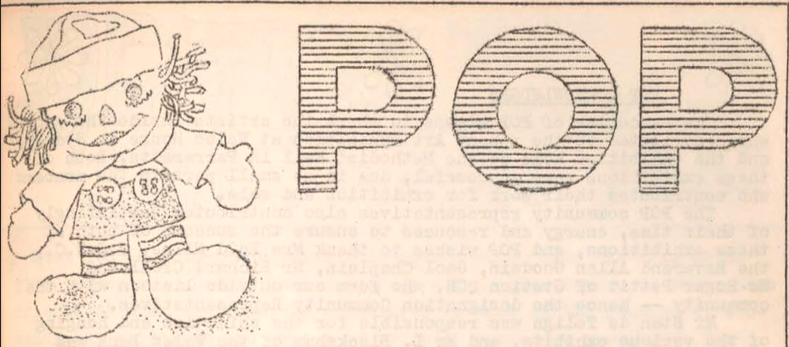
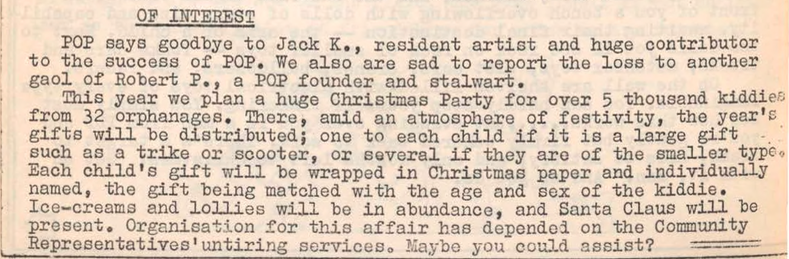
I’m surprised to learn that Jack never saw this message when it was first written. His eyes light up, suddenly making him look ten years younger. “They said this to me? Jack Karlson? Oh, they remembered me,” he beams.
Jack also did oil paintings in prison for POP. They would be sent out for sale, with all the money going to the orphanage project.
Jack’s life in custody is far too complex to cover in just one article. He was put in an orphanage at four, sent to Westbrook Reformatory at age sixteen, then did five years at Boggo Road Jail in Brisbane, eight years in total in NSW, and four in total in Victoria.
Jack escaped from McLeod, a prison farm in Victoria that closed in 1975, on his first day there. Due to the historical escape, the next time he was arrested in Victoria, over fifteen years later, he was sent to the notorious “H Division,” the punishment section of Pentridge Prison. By this stage, however, his reputation as an artist in prison in NSW had preceded him.
Jack tells me something I already know from researching prison history in Australia, that life in H Division consisted of hard, pointless labour during the day, smashing blue-stone rocks with hammers. After a couple weeks of this, Jack was called up to the office of a high-ranking officer who by that stage had gone through Jack’s records and asked whether he’d been part an art group at Parramatta Gaol. Jack explains what happened next.
“I said, ‘Oh, I love painting, Commander.’
He said, ‘Don’t call me Commander! I’m Sir.’
A couple of days later, I’m still cracking these rocks. He called me up to see him. He said, ‘what do you think about this, [and showed] me a picture of a little country town. Can you paint that?’
‘I certainly can, but I’ll need some gear.’
He said, ‘You make a list and give it to me. In the meantime, you can paint the doors of the cells. You’re a painter anyway.’ I wrote out a list, paints and turps. Metho of course, which I drank.’”
Just like art had previously stopped him from being tipped to Goulburn, art was eventually able to get Jack out of H Division and into a regular section of the jail. For Jack, art offered a form of escape, and not just from H division.
“I wanted to escape from the clutches of the enemy, the evil scum that lock people up,” he says about making art in custody.
I want to know how Jack feels knowing that most people don’t know anything about his art, and typically only know him for the internet meme.
“It’s driving me fucking mad,” he says. “You know why? I go into a pub and they say, ‘Hey, Jack, you’re that bloke!’ I want to go into a pub without people coming up saying, ‘You’re that bloke on that democracy manifest.’ I don’t want that.’”
I ask if he’d prefer to be known as an artist. He looks pensive, though also a little annoyed. “Yeah. Not that I ever thought about it, but yeah. If you want to make me an artist, make me an artist. Not a criminal or ex-criminal.”
I also want to know where he thinks he’d be today without art. “Dead,” he says flatly. There’s a silence in which I don’t know what to say. Eventually, I ask him if his art style has changed since his release.
“Oh, I don’t know what to say, I’ve just progressed. Some of my best paintings were done in prison, but I haven’t got them. I’ve given them away to family and friends. Painting is all I do now. I don’t break the law anymore. Oh, I do I drive without a licence. But I’m an artist now. I used to be a criminal ... but no more. All I want now is to wield my brush and paint pictures. I’m a poor struggling artist. Art is beautiful. Art is wonderful. I used to wake up [and it was] the first thing I wanted to do. Leap out with a paintbrush and finish that painting that I was working on last night. Oh, it’s so good for the soul and the heart to paint. That’s what we used to do. I suppose that was what kept me at least half sane. Painting in prison.’
“What were you trying to say with your art?” I ask.
“Oh, no, I didn’t want to say anything. I just wanted to paint beauty.”
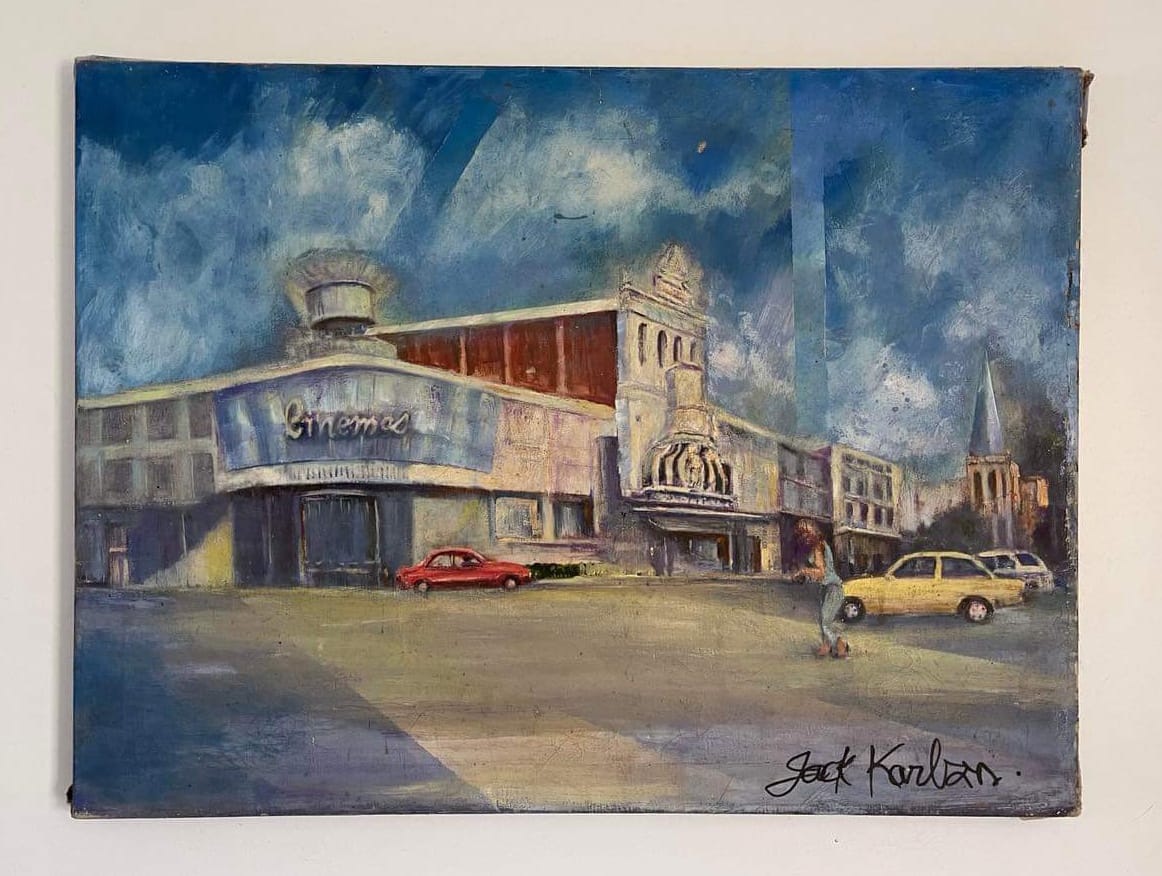
Sadly, Jack died from cancer in August 2024. You’ll be able to see more of this interview with Jack in the upcoming documentary 'Burning Down the House'.