By 'Borris Kerr'. Published in Issue 21 of Paper Chained in March 2026.
It was autumn of 1971 and I was in the city of Vung Tau in what was then South Vietnam. I was serving with the Australian Army, 2nd field hospital, 2nd field ambulance, initially as a medic.
Vung Tau was once named Cape St Jacques, when it was part of French Indochina. The city is a beach resort and was sometimes referred to as the ‘French Riviera’ of southeast Asia. The town supported many restaurants and nightclubs and was quite a cheery place. The people were friendly. At that time the area was the R&R (Rest & Recreation) area for the armed forces and was often populated by some very drunk American, Aussie, and Kiwi troops. They were all treated very well by the locals. They spent a lot of money.
The Yanks were what I called ‘the cheapest bunch of drunks in the world’. Possibly not true, but they could buy 40oz bottles of bourbon, whiskey, gin – you name it – for about $2.50 US, through their P.X., which held no tax or duty added. It was good to make a friend of a Yank – they could get you anything. I don’t know how they got away with it, but they really loved our slouch hats and would pay huge prices for them or trade. I got an automatic pistol for one of mine (of course I had accidentally lost it when it blew at the beach, it was soon replaced – although I was fined $10 for it).
What I found out about Vung Tau was quite a shock to me. It appeared the Vietcong (Charlie) owned many of the businesses and used the money they made to fund their war. Here, however, no-one made waves. The person who served you in the box could well be the enemy, but while they were making money, there was peace.
Crazy fact – at North Beach – the posher end – there were flags on the beach and we were told to swim between them. I presumed these were lifeguard patrolled areas, but when I asked, I was told “No. This is Charlie’s R&R beach – They swim on ‘that’ side of the flag.”
And it was then that I realised that war ‘is’ crazy. A flag makes peace. When I finally was posted home I stole the flag and it hung it on my bedroom wall. I’ll jump forward a bit. My last posting in Vung Tau was as a Provo – a Military Policeman. It was an interesting position but there was a lot of corruption and looking the other way, particularly when it involved inter unit/country conflicts. The Yanks got into a lot of trouble but we Aussies could drink them under the table. Trouble was that most of the Yanks didn’t want to be there and took it out on drinks and drugs. They lacked a lot of discipline and often disliked their officers. We treated lots of self-inflicted wounds on soldiers giving themselves the purple heart and a ticket home.
There was dope everywhere – fortunately I never availed myself – cheap booze was sufficient. There was a gap in the perimeter wire where you could sneak out at night. I did so many times and was caught only once, when I tripped and put myself in hospital with a broken nose. I got seven days heavy duties.
When we were doing our training when we first arrived, we were told to be aware of the locals, particularly the children. We were told that the kids would get close to you, put a grenade in your pocket, pull the pin and run off. Therefore, we were told that if they came close to stop them and if they don’t, to kick them away. I’d be damned if I would ever do that and so I ‘took the risk’. In fact, I disposed of heaps of chocolates.
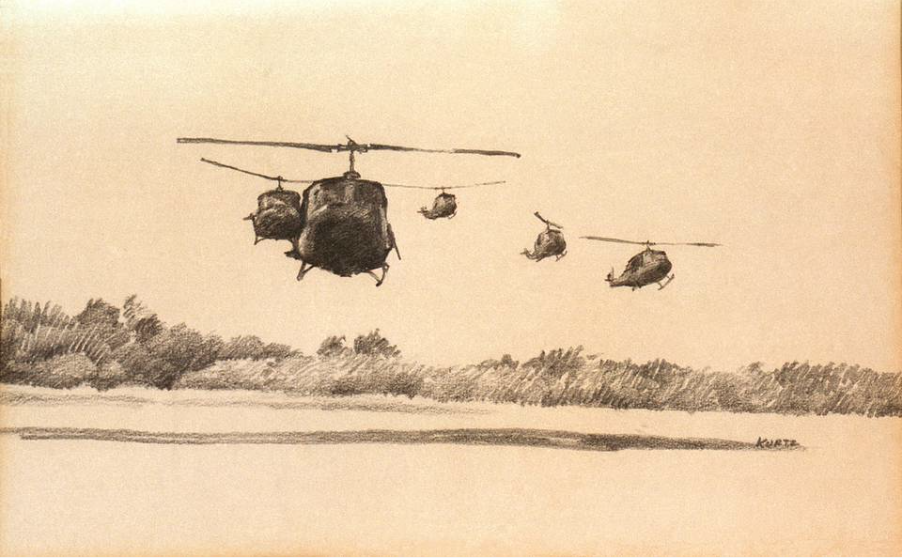
Back to field hospital: My job was going by helicopter to act as what I guess you’d call ‘first response’ now. Load casualties onto the chopper and bring them back to field base. It could be a busy and harrowing time. When I was training, I was not keen on the sight of blood, but when I almost fainted once my commanding officer literally booted me in the bum. ‘You’re no bloody use to me like that. Wake your ideas, man. You can’t help F.A., if you can’t perform’ – and I’ve been OK since.
It wasn’t a dark and stormy night, as most scary stories start. It was a hot muggy morning and it had just stopped raining for what seemed like days. I loaded my kit onto the chopper and our motley crew took off. This was no ordinary flight. A Canadian doctor, American nurse, three escort Yanks and I were on a sort of mercy mission. We had volunteered, forgoing a day on the booze, to help vaccinate a small village to the North of Smallpox, and to provide things like anti-malaria pills. It was at the foot of the hills, out from Phan Thiet to the north. This was only my second such trip, inspired by the ‘flag on the beach’.
As we were approaching, there was smoke towards the hills and the distant ‘pop up’ of sporadic gunfire. Not too unusual in these parts. We carried on as usual. The locals were shy and a little wary of us, but our interpreter put them at ease and we soon settled down to a slow trickle of patients.
After probably an hour, there was movement in the village. Murmuring and restlessness. People were leaving and heading away from where we were gathered. Something was up. Apparently, the Vietnamese had raided a village to the north and were rounding up Vietcong sympathisers. They were very cruel, the South Vietnamese soldiers, and treated sympathisers brutally, with torture and even sometimes execution. We decided we would pack up and leave and come back another day.
From the edge of a wooded area beyond where we had landed, a young girl, we thought about nine or ten, came running, dragging a younger boy behind. She ran towards one of the huts and went inside. Three Vietnamese soldiers came running out of the trees after them. We stopped what we were doing, stunned. One soldier ran into the hut, dragged them both, one clinging to the other, out of the building and flung them to the ground. I don’t know what he was saying but he sure wasn’t happy.
The three Yanks ran up to the soldier and pushed him away. With that, the other two Vietnamese soldiers began shouting aggressively. We picked up, through the interpreter, that the boy was supposedly a courier, who took messages and helped smuggle goods in for the Vietcong. He would be treated as a ‘sympathiser’, the same as an adult. The young girl was, on closer inspection, badly burned. Her clothes were burnt and sticking to her and I am sure she was in a lot of pain. I found out why later. She made for an American, grabbed him by the leg and began what I imagine was begging; in a most heartbreaking manner. The Yank said, “Don’t worry, darling. You’ll be OK. He ain’t going nowhere!”
Pushing, shoving, yelling, threatening – it all became very heated. The doc took the girl, picked her up and headed for the chopper. The Yank soldiers went to get the wounded and hurt boy, and then my life changed.
One of the Vietnamese pulled out a pistol and shot the boy in the head. He then advanced toward the chopper yelling and screaming. ‘We’ broke the law and ‘We’ stopped them: but I never held the gun – and until today I have not spoken of this.
The girl we called ‘Smiley’. She was taken back to base hospital and treated for her burns, the result of escaping from her burning house, which had been set on fire with both of them in it. I treated another man like this. We had come across him dazed, walking down a road. He had burns to his chest with vertical lines about one centimetre apart, running to his waist. There was charcoal and burnt cane running down and sticking to his skin. The soldiers had taken him from his home and told him they were going to burn down his house as his small village was under investigation or whatever they called it. He had begged to keep his caged bird. The soldiers gave him his bird, then they poured petrol on it and set it on fire. They forced the man to keep hold of the cage. And this was how war was.
Smiley was smuggled out of Vietnam, on a military plane to Singapore. She was flown back into Saigon and was given refugee status. I think it was all a bit illegal but Smiley ended up going to Canada, where she was adopted. She’s still there now as far as I know.
You see – I was told going to help the villagers was a waste of time, that we couldn’t do anything. But I did, and I did make a bit of a difference, even if it was for one small girl.
When I returned, I was discharged in Australia and came back to New Zealand and my parents.
I took up the protests against the war in Vietnam. But I did not despise the solders who served there, I respected them. When the Springbok tour was going ahead in the 80s I protested, because I felt strongly about it.
The war finished. The Springbok tour finished and we affected the end of the apartheid.
There is more to this story. There are things I cannot describe and that I wish I could forget.
This writing is not a waste of time for me. It is something I must do before I die.
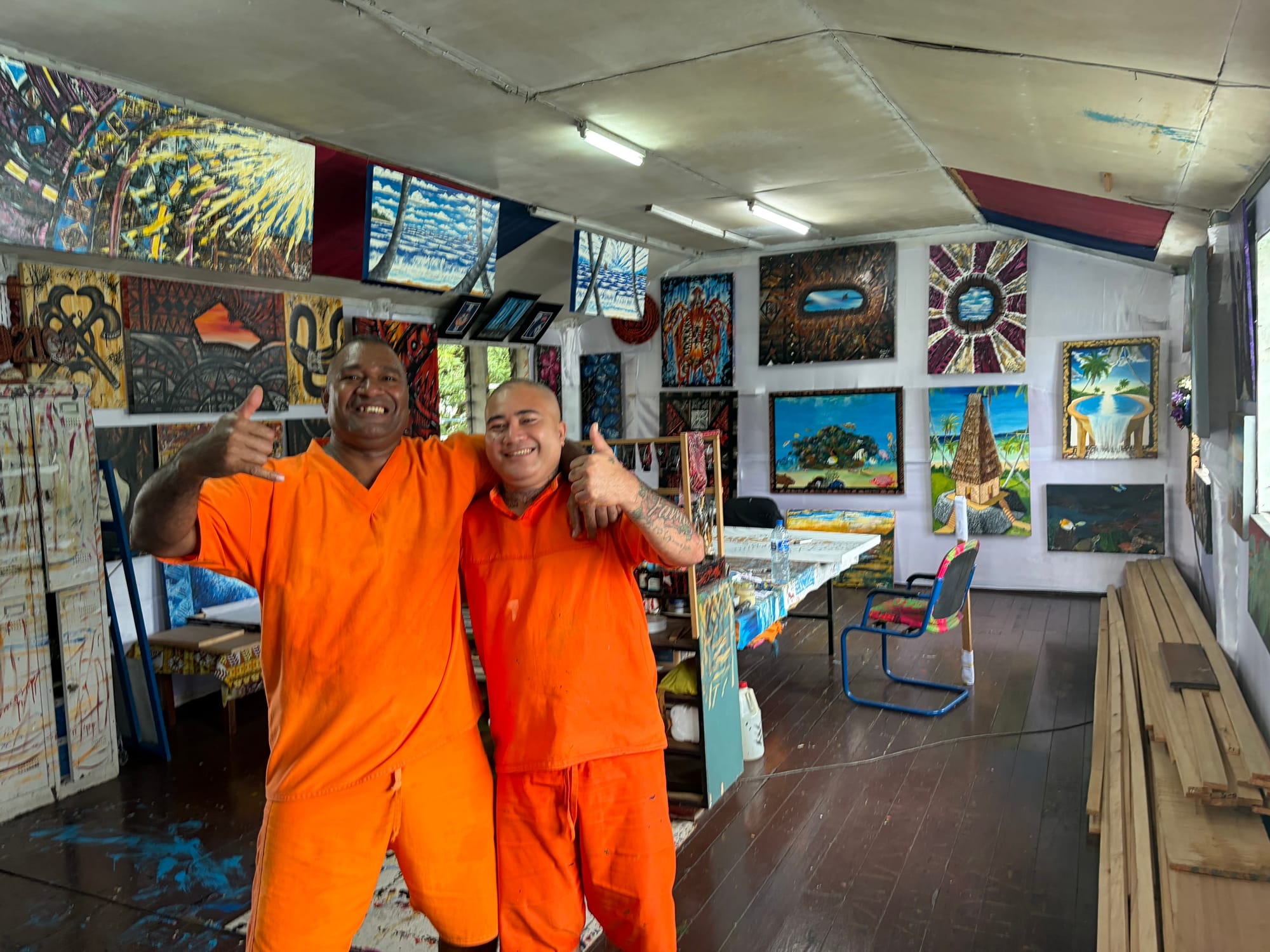
'Borris Kerr' is the pseudonym of a man currently incarcerated in New Zealand.