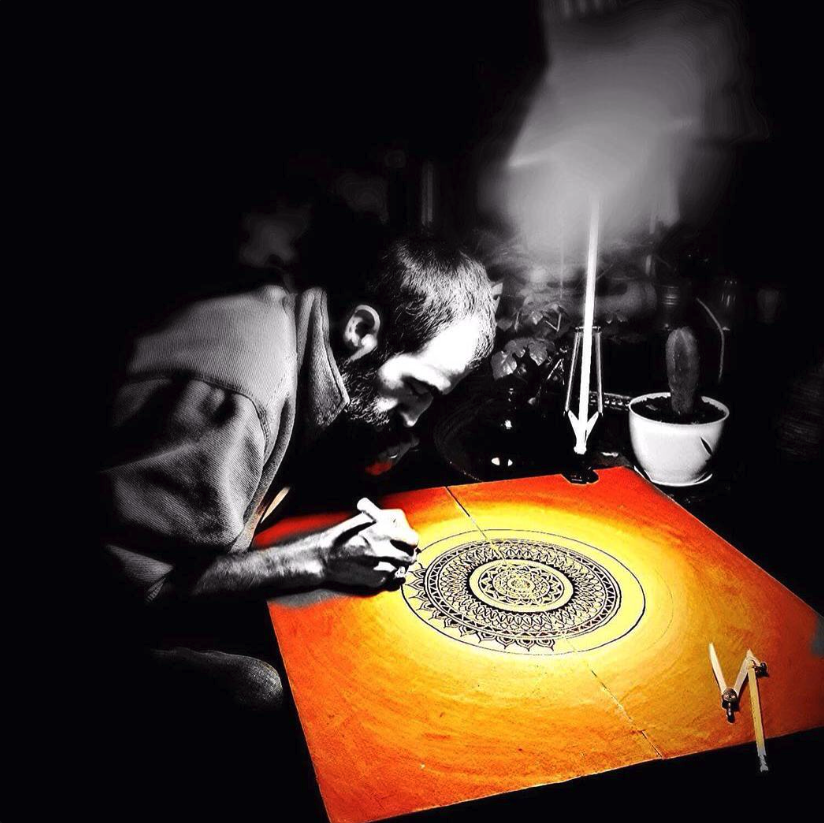
Published in Issue 16 of Paper Chained in December 2024.
Paper Chained Editor Damien Linnane talks to Mohanned Al Azzeh, a Palestinian artist living near Ramallah in the West Bank, who is also a former inmate of Israel’s prison system.
Can you tell me when you first started making art?
In the last few years of school. In 2000, I went to university to study fine arts.
Was that before you were put in prison?
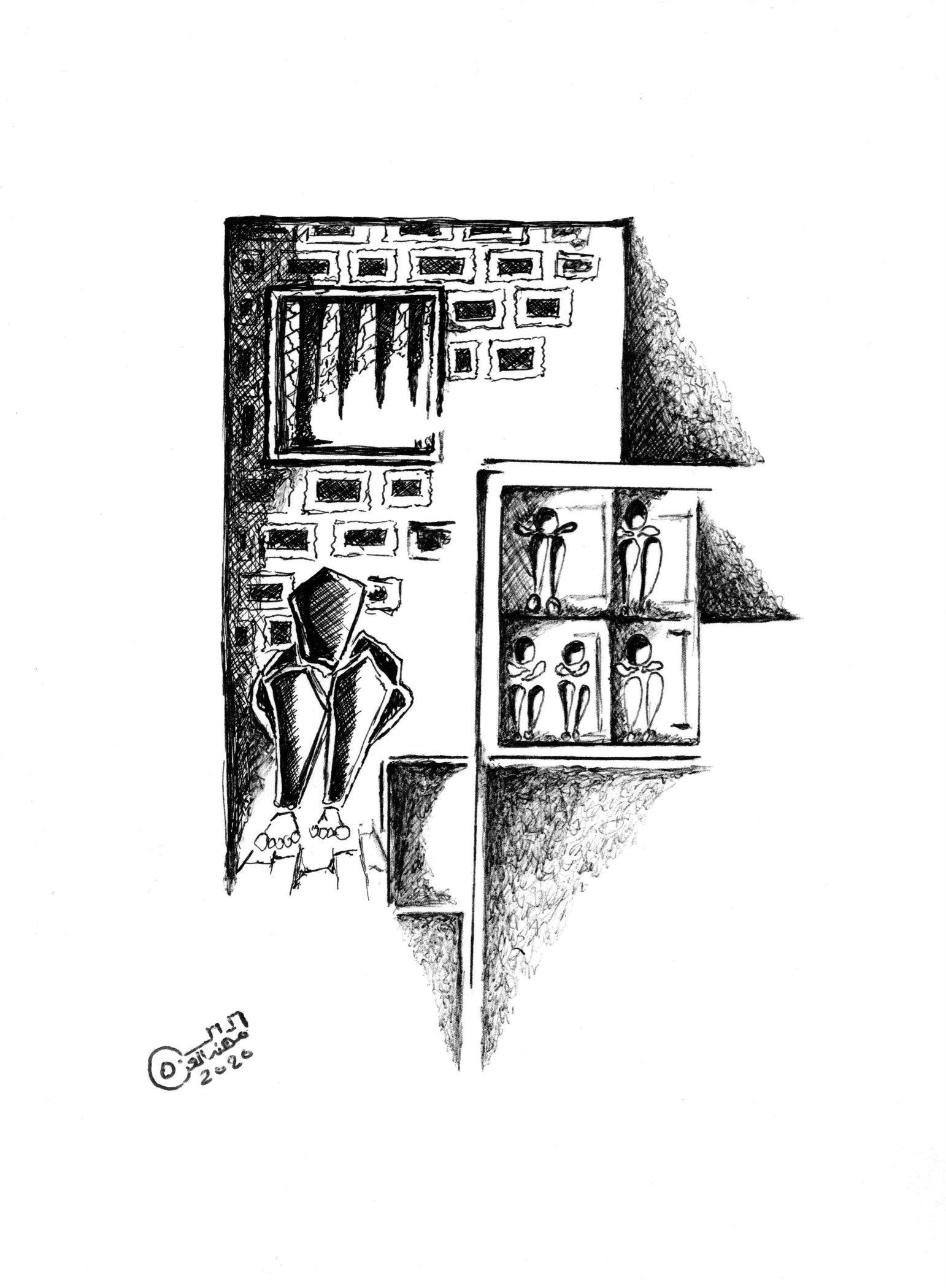
Yes, I was in prison two times. The first time was 2005, for two-and-a-half years, and then again in 2020 for two years. The first time I was arrested for political activity at my university, and the second time it was for refusing to give information about a political party to Israel. This is what they judged me for, they said I was active in a political party, and I had a relation with some of the political party activist people. People are put in prison for being active in political parties, whatever they are doing, not just military action. If we’re seen going to a demonstration in the street, they can send you to jail.
In 2020, the Israeli soldiers came to my house in the middle of the night. My daughter was two years old. About 25 soldiers came into the house with weapons. Three came into my bedroom. I woke up with them shouting at me. They put a weapon to my head and asked me to put my hands behind my back and they cuffed me. Then they started searching the house. They destroyed many things, the walls, the kitchen, the TV. One hour after they finished they took me to the interrogation centre.
In Israeli interrogation centres, they have a rule called 20-20. It means 20 hours per day, for 20 days. The interrogation will go on for 20 days, every day, for 20 hours each day. For 20 hours I will be in the office, with my legs in cuffs, sitting in a small chair attached to the floor. Every day you have 20 hours of questions. Some days I think it was more than 20 hours, but I don’t know because they took my watch. You don’t know what the day is, nor the time of day. You don’t know whether it is morning or night. You are kept in a small room that is exactly two metres by one metre. When I slept, my legs were against the door and my head was near the small place to go to the toilet. I don’t know if I was sleeping one hour or five, because after one week, there is no [concept of] time. I finished the interrogation and they sent me to my room, and I slept immediately.
When you are being interrogated, there are at least three people speaking at you. One of them will shout, one will be speaking in a good way, one is trying to beat you. They shout very bad words. They threaten to rape you and do things to your family. They told me that they would arrest my family, they told me they would arrest my wife and then my daughter would be out on the street. After ten days they showed me a video with no sound of my wife being interrogated as well, in the same place I am in. The interrogation centre is two or three floors underground. It is the same interrogation centre the British were using until 1948.
After 10 or 12 days, I was more of less destroyed physically. They tried to take me back from the office back to isolation, but I fell down and became unconscious. I woke up in hospital, I still don’t know how long I was there for, then they took me back to interrogation in the same place.
After a fews days, you really want to know how much time is going by, so I found a solution to this. During interrogation I would ask them to release my hands so I could drink water. They released one hand, and I put my fingers in the water. I put three drops of water on the table, and I start to count to see how long it takes the water to disappear. Eventually I find out that a drop of water a certain size will take one-and-a-half hours to disappear, so this is how I count how many hours I am in interrogation for. I do this when I am sleeping too. I put drops of water in the cell, and most of the time when they wake me up, the drop of water that takes 20 minutes to dry is still there, so this is how I found out that they were only letting me sleep for around 10 minutes sometimes. Sometimes the soldiers would find out I was doing this and they would punish me, or they would not give me more water to drink.
I was in interrogation for 60 days. The food was very bad. I weighed 65 kilos when I went in; when I came out I weighed 45 kilos. They only took me from my cell, to the office for interrogation, and every 10 days to have a shower for five or ten minutes. But they didn’t give me new clothes. They also always blindfolded me when taking me from the cell to the interrogation office or the showers. I never saw anything when I was walking between these places. This was during COVID, and sometimes when I was blindfolded they would stick the swab in my nose to test me, but they would never tell me first. Sometimes people would also come to my isolation cell and say “We will help you if you tell us what you know, we are a prisoner just like you”, but they are fakes. They are part of the interrogation.
After a month and a half I started to have back problems from being chained to the chair in the interrogation. They refused to give me medication for the pain. They said, “If you speak with us, if you tell us everything, we will take you to the hospital and give you what you want, but if you stay not speaking, we will not give you anything.” I still have pain in my back all the time.
Eventually they sent me from the interrogation centre to a normal jail, which was Ofer Prison in the West Bank . I was put in a room with eight other people. I started trying to find out news about my family, I started trying to meet with a lawyer about my case.
Were you able to make any art once you got to Ofer?
I made some art, but for the first year, only one kind. The International Red Cross gave us dominoes when they visited us. Prisoners took the dominoes and sanded them back by rubbing them against the ground, to make them very soft. Once both sides were polished back, they gave them to me, and I would do small drawings on them to turn them into pendants for necklaces. Normally I would just make these in black and red, because it is hard to get other colours. We do not have coloured pencils in the adult prison. In the children’s section of the prison, they are allowed to have colouring pencils. The red I got was smuggled to me from a boy in that section of the prison.
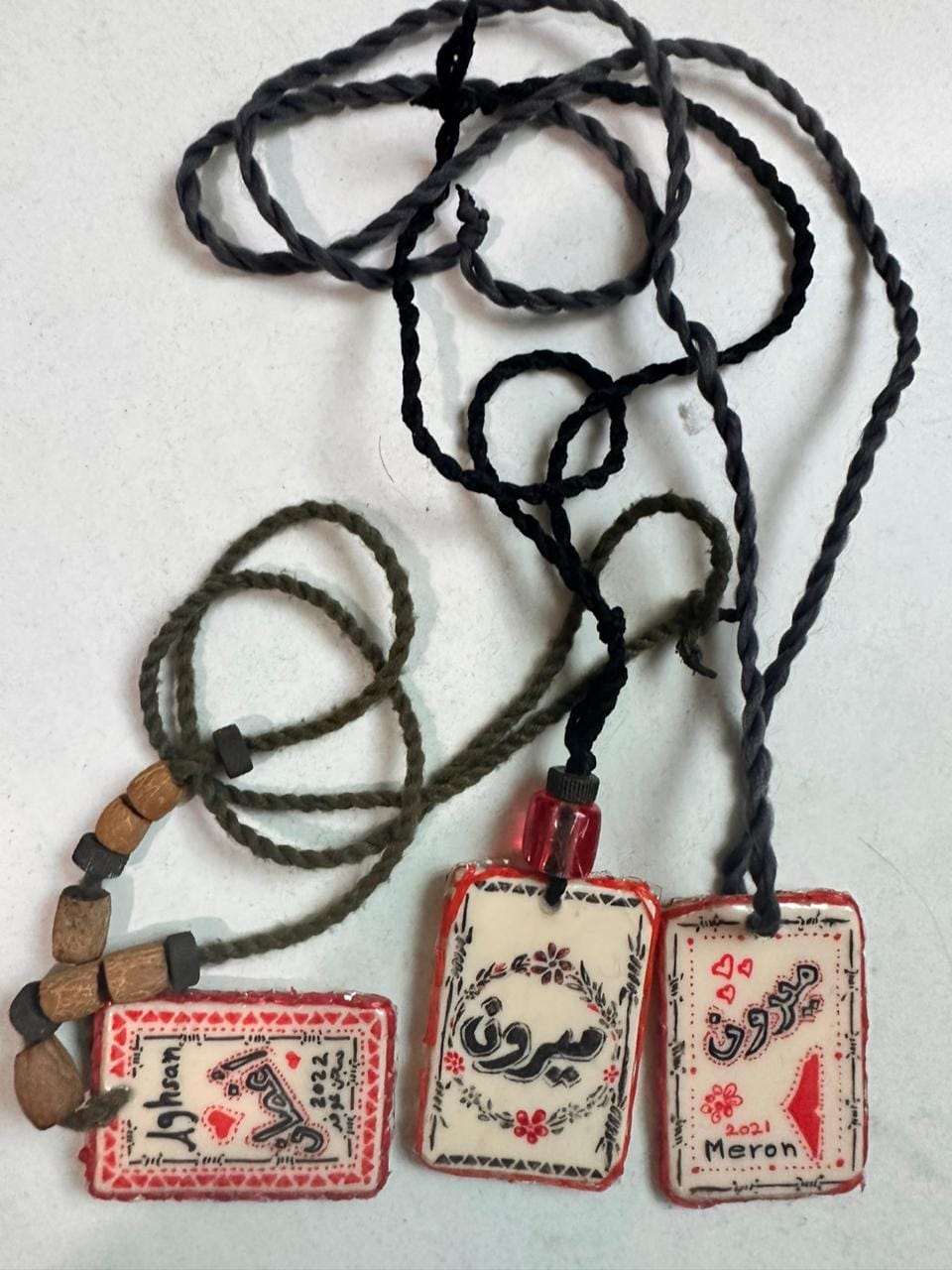
The pendants are gifts for family, wives and children. There are many steps to making this art. We cover the dominoes with a kind of plastic cover that we get from water bottles. We have a lot of time to make decorations in jail. The beads on these necklaces that look like wood, but they are actually olive seeds. The other decoration you see is the flint wheels from lighters. We aren’t allowed art materials in prison but they do let us have lighters for smoking.
I also made some drawings which I smuggled out of the jail in a secret way. I can’t tell you how because this method still works and prisoners still use it now. I did around 20 drawings on paper, which I got in different ways since we are not allowed to have paper for drawing. If prisoners are going to court, most of the time the judge will give them a piece of paper at the end related to the hearing. When prisoners come back from court they cut the white paper and give me any blank sections, which I use for drawings. I was doing special drawings for my daughter, about how to learn letters and numbers, and how to learn the names of animals. Once I was able to make a portrait drawing of my daughter that was blue, because I was able to get a blue pencil.
Did you make any other kinds of art?
I made paintings on t-shirts with bleach. Each month the Israelis gave every room half a cup of bleach for cleaning. We are not allowed to have colourful clothes in prison, only black, brown and grey. I would take black shirts and I would paint on it with the bleach. After a while the t-shirt turns white where you paint it. This is the kind of art I do, and all the time we are trying to find a way to make sculptures or drawings. But most of the time when we do something, and the soldiers find it during the searches of the rooms, they take it with them. They do searches every day.
What are you dong with your art now?
Just a few months ago I finished a diploma in art therapy. I am taking this art therapy to help fix things from the time I spent in jail, because I have some problems from being in jail. They are not big problems for me, but I live with my family and sometimes I make them very afraid of me. So, I’m trying to do some kind of meditation or therapy. This kind of thing is not common here. People are too afraid to say “I want to see a psychologist.”
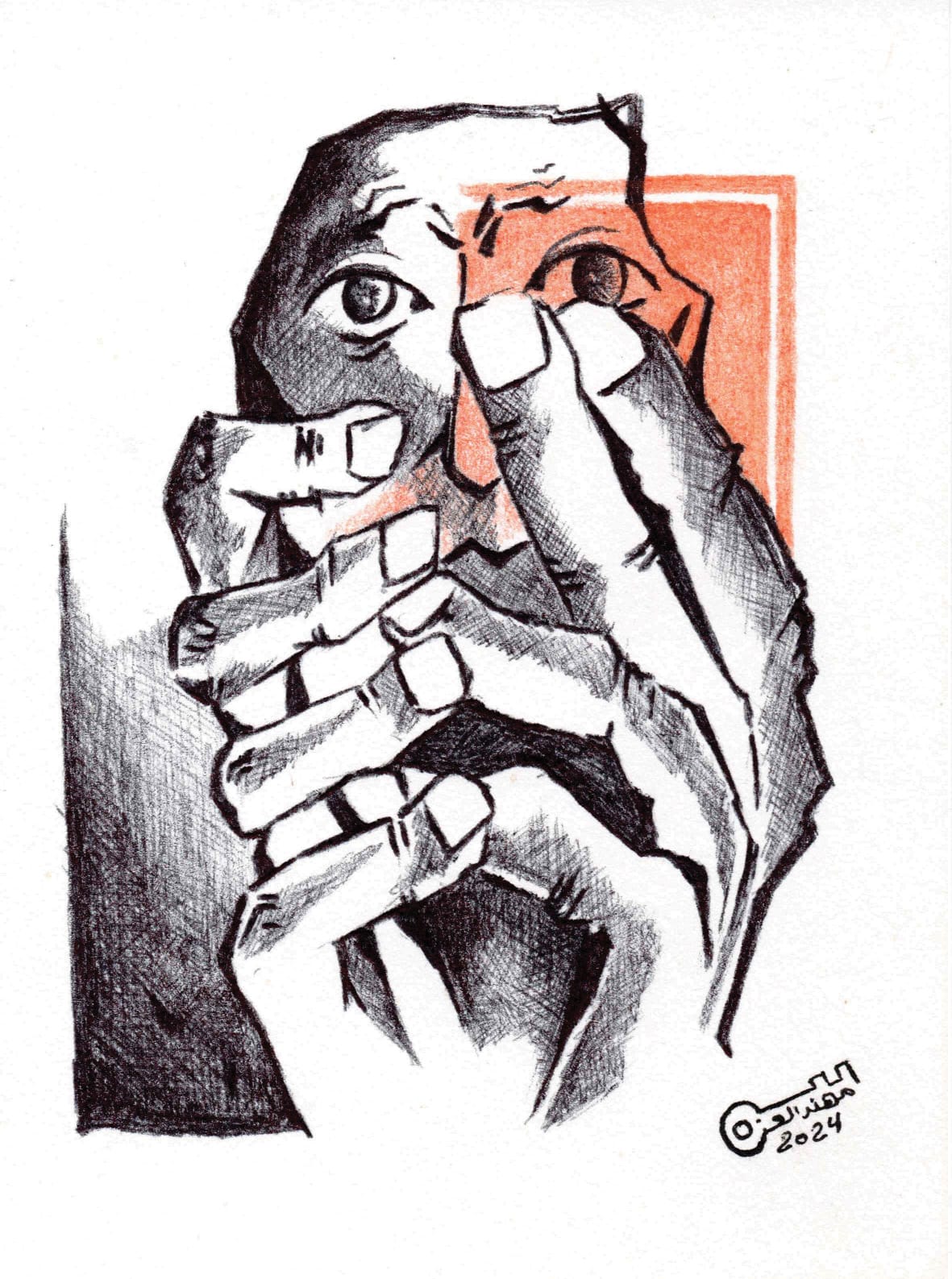
So, I’m taking this art therapy diploma, because my study is art, and I spoke to my doctor and they said, “If you’re afraid about something, or if you think about something all the time, it’s better to do something about it”. Because I told him that I want to try to do something to vent about what I experienced in the prison. “Don’t think about it all the time”, he said, “Just do it. Bring the colours and everything, and start to do any arts to express the feelings of when you are in the jail”. And this is how I want to spend my days. I make sketches, a different kind of sketch, and I’m trying to finish the first step to make a painting about the life of the jail. This is what I do. In the near future, I will try to do an exhibition about the prison life. Most of the time when I make art though I have to send it outside my house, because at any moment the soldiers might come in to my home and destroy everything again.